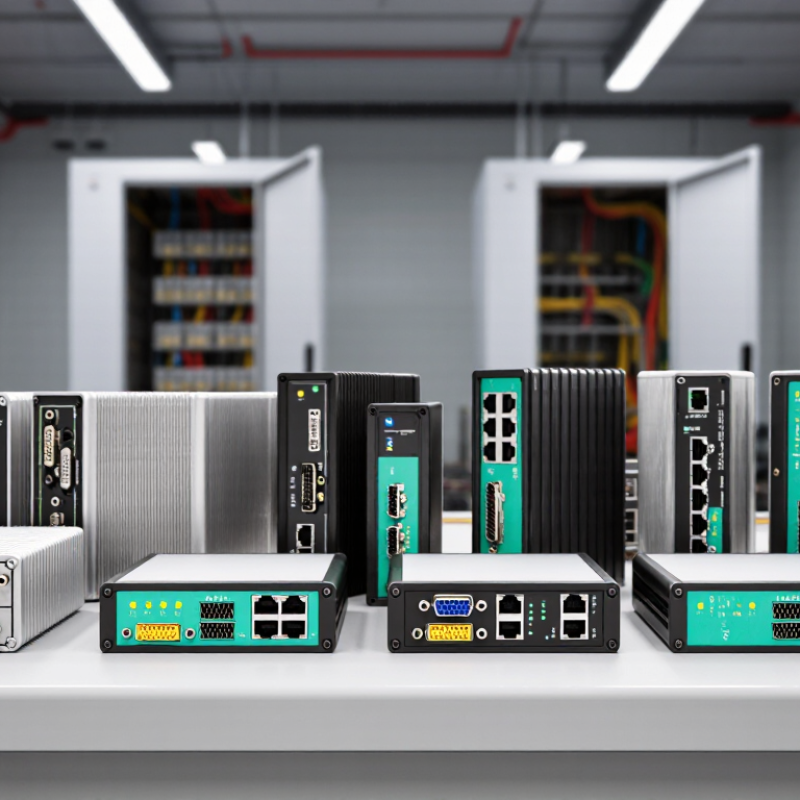
Choosing the right Industrial Communication Module in 2026 requires more than comparing interface names and advertised speeds. Buyers must connect technical specifications with real operating conditions, including temperature, vibration, network distance, protocol requirements, and maintenance access. A module installed inside a factory cabinet may face electrical noise, dust, heat, and unstable power. Those details matter.
This guide examines major module types used for industrial Ethernet, fieldbus, serial communication, wireless connectivity, and protocol conversion. It considers practical selection factors such as Modbus, PROFINET, EtherNet/IP, CAN, RS-485, MQTT, and OPC UA compatibility. It also reviews mounting methods, diagnostic tools, cybersecurity features, lifecycle support, and integration effort. Look beyond the product label.
Experienced engineers often test communication modules under realistic loads rather than trusting a laboratory headline. A stable connection during a short demonstration does not guarantee reliable operation across a large production line. Buyers should request datasheets, firmware policies, environmental ratings, and documented interoperability results. Independent certification can strengthen confidence, but it does not replace application testing.
Some decisions remain imperfect. The cheapest module may create expensive downtime later, while an advanced model may exceed the project’s actual needs. Wireless options can simplify installation, yet metal structures and interference may reduce performance. This article helps buyers compare those trade-offs clearly and identify the module type that fits their equipment, network architecture, and long-term maintenance plan. Context wins.
Industrial communication modules connect machines, controllers, sensors, and supervisory systems. They translate data between devices using defined communication protocols. A module may support serial links, industrial Ethernet, fieldbus networks, or wireless connections. Its job is more than moving bits. It manages timing, addressing, message formatting, and error detection.
Inside a cabinet, the module receives data from a sensor or controller. It checks the message for errors. Then, it converts the information into a format another device understands. Some modules provide protocol conversion between older equipment and newer networks. Others add remote input and output, allowing operators to monitor temperature, pressure, or motor status from a central system. Diagnostics can show lost packets, voltage problems, or communication delays. That detail matters during maintenance.
Field commissioning often exposes weaknesses that brochures miss. A module may meet the required speed but struggle near electrical noise. A wireless unit may work well in testing, then lose stability behind metal panels. Isolation, operating temperature, mounting space, and firmware support deserve careful checks. Do not select by protocol alone. Confirm data capacity, response time, connector design, security controls, and compatibility with existing controllers. Documentation should explain recovery behavior after power loss. It should also identify update procedures and testing requirements. No module is perfect. A careful buyer leaves room for that reality.
Industrial communication modules are the link between machines, controllers, sensors, and supervisory systems. In 2026, buyers should understand the main module types before comparing specifications.
Ethernet modules support fast data exchange across modern factory networks. They commonly connect PLCs, industrial computers, remote I/O, and monitoring platforms.
Serial modules, including RS-232 and RS-485, remain useful for older instruments and simple machine networks. They are affordable and easy to retrofit. However, cable quality and grounding can strongly affect performance.
Fieldbus modules support established protocols used in process equipment and automation cells. CAN-based modules suit vehicles, motion systems, and compact machines requiring reliable local communication. Protocol gateway modules translate between incompatible networks, reducing costly equipment replacement.
Wireless modules use Wi-Fi, cellular, or low-power radio connections for mobile assets and difficult cable routes. Fiber-optic modules provide strong noise immunity over long distances. Field conditions matter.
In practical purchasing, check isolation, operating temperature, connector strength, diagnostics, redundancy, and cybersecurity controls. A module may pass a bench test yet fail near motors or welding equipment.
I have seen installation assumptions cause more trouble than hardware limits. That deserves attention.
Buyers should also verify protocol compatibility, update methods, support documentation, and spare-part availability. The fastest module is not always the most dependable choice. A carefully matched, well-documented module usually delivers better lifecycle value.
Choosing an industrial communication module starts with the network requirement, not the product name. Ethernet modules suit high data volumes, remote diagnostics, and many connected controllers. Serial modules remain practical for simple meters, drives, and older equipment. Wireless modules help when cables are expensive or moving machinery creates installation challenges.
Match the module to real operating conditions. A fast network still fails if vibration loosens connectors or electrical noise corrupts packets. Check bandwidth, latency, protocol support, topology, temperature range, and enclosure rating. A factory cabinet may reach 55°C during summer. A warehouse link may cross steel structures and suffer unstable signals. Security features, firmware updates, and long-term spare availability also matter. I have seen projects choose maximum speed, then discover that their sensors generate very little data. That decision added cost without improving control.
Tips: List every device, cable length, data rate, and required response time. Test the module beside motors, inverters, and metal panels. Measure packet loss during startup and peak production. Keep one spare unit for maintenance. Do not trust a laboratory result alone.
A useful selection process compares normal and worst-case conditions. Use Ethernet for demanding control traffic, serial communication for limited legacy devices, and wireless links for flexible access. Cellular modules can support remote assets, but signal coverage and service continuity require verification. This matching is rarely perfect. Requirements change, and early assumptions can age badly. Document the reasons behind each choice, then review them before deployment.
When buyers compare 2026 industrial communication modules, protocol support is only the starting point. The 2025 Industrial Network Market Study reported industrial Ethernet at 71% of new installations, versus 22% fieldbus and 7% wireless. That shift favors modules with deterministic Ethernet, broad interoperability, and simple migration paths. Check protocols, connector types, cycle time, jitter, and maximum node counts. A module may claim multi-protocol support, yet require separate firmware or licensing.
Reliability needs measurable evidence. Compare operating temperature, isolation voltage, vibration ratings, failure data, and diagnostic depth. NIST SP 800-82 Rev. 3 stresses segmentation, asset visibility, and secure remote access in operational technology. Therefore, inspect secure boot, signed updates, role-based access, and event logs. Ask for test conditions, not attractive laboratory figures. Small details matter. A loose terminal can interrupt an entire production cell.
Integration speed also affects total cost. Review engineering software, API quality, configuration backup, and replacement procedures. The 2024 World Robotics report recorded more than 500,000 industrial robot installations globally in 2023. This increases demand for synchronized, low-latency communications. Still, the fastest module is not always the best choice. In my field evaluations, clear diagnostics often saved more downtime than higher headline speed. I would challenge one assumption: a five-year forecast can be wrong. Select hardware with firmware longevity, spare capacity, and documented fallback modes.
| Module Type | Typical Physical Interface | Common Protocols or Standards | Typical Data Rate | Typical Network Reach | Key Strengths | Important Buyer Checks | Best-Fit Applications |
|---|---|---|---|---|---|---|---|
| Industrial Ethernet Module | Shielded twisted-pair Ethernet; copper or fiber options | Industrial Ethernet, TCP/IP, UDP, VLAN, SNMP, time-sensitive or real-time Ethernet variants | 100 Mbit/s to 1 Gbit/s is common; higher rates are available in selected systems | Typically up to 100 m per copper segment; fiber can extend from hundreds of meters to several kilometers depending on optics | High throughput, broad software integration, diagnostics, scalable topologies, and support for large device populations | Required protocol stack, managed or unmanaged operation, redundancy, synchronization, connector type, EMI immunity, and cybersecurity features | PLC networks, machine control, factory automation, vision systems, and plant-wide data collection |
| Serial Communication Module | RS-232, RS-422, or RS-485 terminals and connectors | Modbus RTU, ASCII-based protocols, and application-specific serial protocols | From low baud rates up to several Mbit/s, depending on interface standard and cable conditions | RS-232 is generally intended for short point-to-point links; RS-485 can commonly reach about 1,200 m at lower speeds | Low cost, simple commissioning, broad legacy-device compatibility, and good noise tolerance with differential signaling | Isolation, termination, biasing, node count, baud-rate support, half- or full-duplex mode, and surge protection | Legacy controllers, meters, drives, sensors, building systems, and retrofit projects |
| CAN / CAN FD Module | Differential two-wire CAN bus with a transceiver interface | CAN 2.0, CAN FD, and higher-layer profiles such as device-oriented CAN networks | Classical CAN is commonly up to 1 Mbit/s; CAN FD can use faster data phases, subject to network design | Reach depends strongly on bit rate; approximately 40 m at 1 Mbit/s and longer distances at lower rates are typical design references | Message prioritization, robust error handling, efficient short messages, and predictable arbitration | CAN FD support, bit timing, termination, galvanic isolation, identifier filtering, transceiver protection, and profile compatibility | Mobile machinery, motion subsystems, power equipment, embedded control, and distributed sensors |
| Fieldbus Module | Two-wire fieldbus cable, shielded twisted pair, or dedicated bus connector | Process and factory fieldbus families, including cyclic I/O and device-parameterization profiles | Common implementations range from tens of kbit/s to approximately 12 Mbit/s, depending on the fieldbus | Often hundreds of meters; exact distance depends on cable type, baud rate, repeaters, and segment design | Mature device ecosystem, deterministic cyclic exchange, established diagnostics, and suitability for long control segments | Existing plant standard, device-description files, segment limits, termination rules, intrinsic-safety requirements, and spare-parts strategy | Process instrumentation, distributed I/O, drives, older production lines, and brownfield modernization |
| IO-Link Master Module | Point-to-point three- or four-wire sensor/actuator connections | IO-Link point-to-point communication with standard switching signals as a fallback | Up to 230.4 kbit/s for the fastest standard communication mode | Up to 20 m per device connection under standard installation conditions | Parameterization, sensor diagnostics, identification data, and replacement without manual reconfiguration | Port count, class A or class B ports, current capacity, IP rating, device-description support, and upstream Ethernet or fieldbus interface | Smart sensors, actuators, condition monitoring, packaging machines, and high-density machine I/O |
| Industrial Wi-Fi Module | 2.4 GHz, 5 GHz, or newer industrial wireless radio with external or internal antennas | IEEE 802.11 WLAN, WPA2/WPA3 security, VLAN, roaming, and industrial application protocols over IP | Theoretical PHY rates range from tens of Mbit/s to multiple Gbit/s; actual throughput is lower and site-dependent | Typically tens of meters indoors and potentially hundreds of meters with suitable antennas and line of sight | Reduced cabling, mobility, rapid deployment, and access to moving or difficult-to-wire equipment | Spectrum survey, roaming behavior, latency variation, antenna placement, interference, encryption, and industrial temperature rating | Automated guided vehicles, mobile terminals, flexible production cells, and temporary or rotating equipment |
| Industrial Cellular Module | Cellular modem with SIM or eSIM, antenna connectors, and Ethernet or serial host interface | 4G LTE, LTE-M, NB-IoT, or 5G, depending on network availability and module category | From low-rate IoT profiles to hundreds of Mbit/s or more on suitable 4G/5G deployments | Wide-area coverage; practical range is determined by operator coverage, spectrum, antenna design, and local regulations | Remote access, geographically distributed assets, backup connectivity, and deployment without local wired infrastructure | Band support, carrier certification, data plans, private-network compatibility, VPN, fallback modes, power consumption, and lifecycle availability | Remote monitoring, utilities, fleet equipment, isolated sites, predictive maintenance, and service access |
| Industrial Bluetooth / Low-Power Wireless Module | 2.4 GHz radio with integrated or external antenna | Bluetooth Low Energy, Bluetooth Classic, and application-layer wireless profiles | Bluetooth Low Energy commonly supports up to 2 Mbit/s PHY rate; usable application throughput is lower | Usually a few meters to tens of meters; longer line-of-sight ranges require suitable radio class and antenna design | Low power consumption, convenient commissioning, compact hardware, and direct connection to portable devices | Pairing policy, authentication, interference, battery profile, coexistence, update mechanism, and required gateway architecture | Tool connectivity, portable diagnostics, wearable devices, battery-powered sensors, and local commissioning |
| Wireless Mesh Module | Sub-GHz or 2.4 GHz radio with mesh-capable firmware and antenna | Industrial mesh or low-power mesh protocols with multi-hop routing | Commonly from tens of kbit/s to a few Mbit/s, depending on frequency, modulation, and protocol overhead | Can cover large facilities through multiple hops; range per hop is commonly tens to hundreds of meters | Flexible coverage, path redundancy, reduced cabling, and support for distributed low-to-moderate data volumes | Route recovery time, maximum hop count, battery life, network capacity, channel planning, security, and gateway redundancy | Large warehouses, environmental monitoring, asset tracking, lighting, and hard-to-wire facilities |
| Edge Gateway Module | Multiple ports such as Ethernet, serial, CAN, USB, and optional wireless interfaces | Protocol conversion, MQTT, OPC UA, REST APIs, secure VPN, and local data-processing functions | Determined by the slowest connected interface and processing workload; Ethernet uplinks commonly support 100 Mbit/s or 1 Gbit/s | Local machine network plus upstream plant, cloud, or wide-area connection | Protocol interoperability, data normalization, buffering during outages, analytics at the edge, and remote management | Supported drivers, CPU and memory capacity, container or application support, secure boot, update process, certificates, and long-term software maintenance | Brownfield integration, cloud connectivity, condition monitoring, production dashboards, and multi-protocol systems |

2026 Top Industrial Communication Module Types for Buyers?
Current Trends Shaping Industrial Communication Module Selection
Industrial communication modules are becoming more than protocol converters. Buyers now assess data speed, cybersecurity, diagnostics, and lifecycle support together. A module must connect sensors, controllers, drives, and cloud systems without creating hidden delays.
Ethernet-based modules remain popular, especially where real-time control matters. Time-sensitive networking is gaining attention in synchronized production lines. Wireless options also help connect rotating equipment and difficult-to-wire areas. However, wireless performance can change near metal structures, motors, and thick concrete walls. Field testing still matters.
Edge processing is another strong selection factor. Modules can filter vibration readings locally and send only useful events upstream. This reduces network traffic and supports faster maintenance decisions. Secure boot, encrypted communication, access control, and signed firmware should be standard questions during evaluation. They are not optional extras.
Interoperability is shaping purchasing decisions. Buyers increasingly prefer open interfaces and clear diagnostic data. A module that works today but limits future expansion can become expensive. I have seen teams choose low-cost hardware, then struggle with undocumented settings and weak replacement options. That mistake is avoidable, but not always obvious.
Environmental ratings also deserve close attention. Temperature, moisture, electrical noise, and vibration can shorten service life. Check these conditions against actual installation data, not only catalog claims. No selection checklist is perfect. Engineers should leave room for pilot testing, operator feedback, and changing security requirements. Reliability often comes from small details, such as readable status indicators and simple recovery procedures.
Current trends shaping industrial communication module selection, comparing commonly specified nominal communication rates.
Nominal data rates are based on commonly used protocol and physical-layer specifications. Actual throughput depends on network topology, cycle time, packet size, distance, device load, and implementation.
"*" indicates required fields