
Learn more about how Trevisan’s Horizontal Machining Centers can help you minimize set up time and labor costs.

How to Choose a Cascade Retort for Food Processing?

Choosing a Cascade Retort is not just a question of capacity. It means matching the heating process to the product, container, and production line. A thick stew in a deep tray heats differently from soup in a pouch. That difference affects process time, product quality, and throughput.

The FAO’s 2024 State of Food Security and Nutrition in the World report estimated that 2.33 billion people experienced moderate or severe food insecurity in 2023. Safe, shelf-stable foods matter. For processors, the choice of retort must support a validated thermal process, not simply promise faster cycles. U.S. FDA regulations in 21 CFR Part 113 also require scheduled processes for relevant low-acid canned foods. Requirements vary by market, so verify them with qualified process authorities.

Food engineering expert Dennis R. Heldman’s work emphasizes the importance of applying engineering principles to food processing. A concise paraphrase of that principle—not a verbatim quotation—is: “Choose around the process, not the machine.” Keep that distinction in mind. Compare cascade water distribution, temperature uniformity, load configuration, controls, and cleaning access. Ask suppliers for data from comparable products and packages, then review it with a qualified thermal-process specialist. A glossy specification sheet is not enough. This guide explores how to assess those details and select a Cascade Retort suited to your actual line.
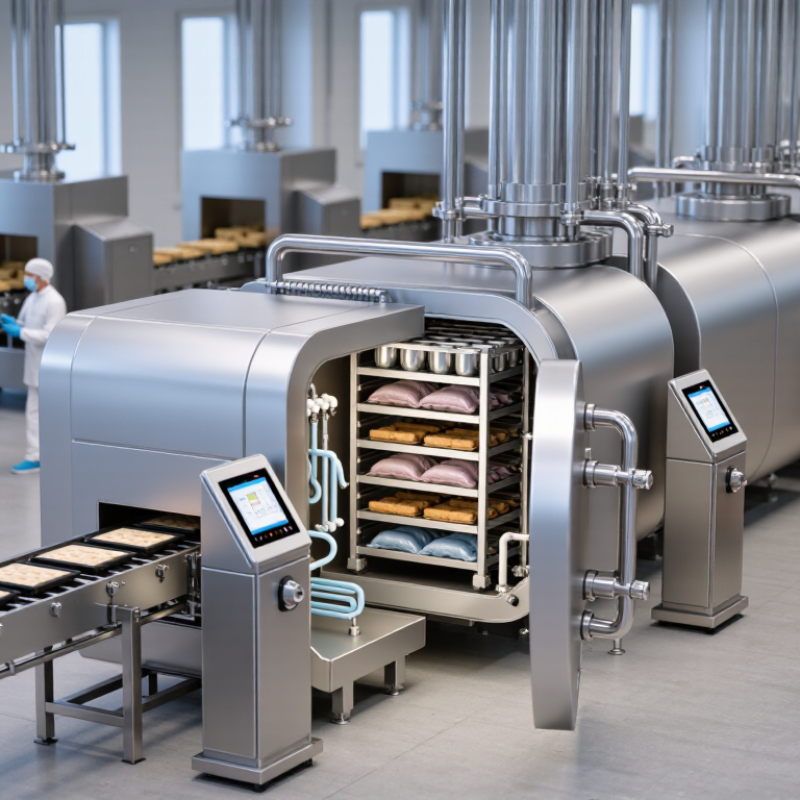
How to Choose a Cascade Retort for Food Processing?

Identify Product Characteristics and Processing Requirements

Before choosing a cascade retort, describe the product as it will enter the package. Record its thickness, viscosity, particle size, and starting temperature. A thin soup heats differently from a dense sauce with large vegetable pieces. Note whether solids settle, float, or change position during processing. Small details matter.

Heat transfer also depends on the package. Glass jars, metal cans, and flexible pouches respond differently to heating and cooling. Measure the package dimensions and fill weight, and identify the headspace and closure. Then define the required processing outcome and expected batch size. A qualified process authority should establish and validate the schedule for the specific product, package, and retort conditions. Do not assume one recipe or container size can use the same schedule. That is not enough.

Consider how a cascade retort distributes heated water across the load. Ask whether packages need agitation, and check that the proposed loading pattern allows consistent water contact. A crowded basket may behave differently from a partially filled one. Include cooling needs, available utilities, and cleaning routines in the assessment. I would also keep a written record of product and package variations; they are easy to overlook during equipment selection.

How to Choose a Cascade Retort for Food Processing?

Identify product characteristics and processing requirements before selecting a retort.

This illustrative chamber-temperature profile uses 121.1°C as a common reference temperature for retort sterilization; it is not a validated process schedule. Actual time and temperature must be established for the specific product and package by a qualified process authority. When choosing a cascade retort, consider product viscosity and particle size, container material and dimensions, target lethality, cooling needs, and required throughput.

Calculate Batch Capacity and Required Production Throughput

How to Choose a Cascade Retort for Food Processing?

Calculate Batch Capacity and Required Production Throughput

Size a cascade retort around saleable output, not its advertised chamber volume. Start with hourly demand: required packages per shift divided by available processing hours. Then calculate a realistic batch load from basket dimensions, package footprint, layer count, and spacing for water circulation. For example, 12,000 cans over an eight-hour shift means 1,500 cans per hour before allowance for loading, cooling, and changeovers. That is the target to test against actual cycle times.

Use the full cycle, not just the heating phase. A 90-minute process with 20 minutes for loading and unloading allows about four batches in an eight-hour shift, before downtime. If each batch holds 1,000 cans, theoretical output is 4,000 cans per shift; real output will be lower. Model a conservative operating factor, then verify it during a production trial. Small details matter. Basket gaps, can dimensions, and cooling time can change the count. Some estimates look tidy on paper. They may still be wrong.

For low-acid canned foods, FDA regulations define the relevant category using a finished equilibrium pH above 4.6 and water activity above 0.85 (21 CFR Part 113). The scheduled thermal process must be established by a qualified person, so throughput calculations cannot justify shortening a validated cycle. Ask the retort supplier for load-specific cycle data, including come-up and cooling times, and have your process authority review the proposed configuration. That step can reveal an awkward mismatch: the chamber may fit the batch, but the line may not feed it fast enough.

Evaluate Heat Distribution and Cascade Retort Design

A cascade retort should be judged by how evenly heated water reaches every container, not by its control-panel setpoint. Check spray coverage, circulation rate, loading pattern, and temperature differences between upper and lower baskets. During a heat-distribution study, map temperatures at multiple positions under the intended operating conditions. Then confirm product heating behavior with a qualified process authority; chamber readings alone do not prove that the slowest-heating container receives the required process.

Small gaps matter. A tightly packed load can obstruct water flow, while a poorly placed sensor may miss a cold zone. WHO’s 2015 Global Burden of Foodborne Diseases report estimated 600 million foodborne illnesses and 420,000 deaths annually worldwide, underscoring the need for validated controls.

For low-acid canned foods in the United States, FDA 21 CFR Part 113 requires processors to establish and document scheduled processes. Treat that as a regulatory reference, not a universal design recipe. In practice, a clean-looking spray pattern can still hide uneven heating; repeat mapping after changes to load size, container format, or circulation settings, and record the results.

Compare Automation, Safety Controls, and Utility Needs

A cascade retort should match the plant’s products, batch sizes, and operators’ experience. Automation can control heating, cooling, pressure, and process timing with consistent setpoints. For mixed product runs, stored recipes reduce repeated manual entries. Still, a screen full of options is not automatically safer. Operators need clear alarms, readable process records, and training for interruptions or sensor faults. Keep it practical. During a site review, ask who can change a recipe and how those changes are recorded.

Safety controls deserve close inspection. Check that temperature and pressure sensors are monitored, alarms are audible on the floor, and the retort cannot proceed when required conditions are unmet. Ask how the system responds to a power loss or interrupted cycle. These details matter more than a polished interface. Utility needs can also shape the choice: confirm steam capacity, cooling-water flow, electrical supply, drainage, and space for service access. Measure them during busy production, not only on a quiet shift. A utility estimate may look adequate on paper, yet fluctuate when other equipment starts. Have qualified process and engineering staff verify the proposed operating range for the actual product and container. One detail is easy to overlook: leave room to inspect valves and clean around the vessel.

Assess Installation, Maintenance, and Lifecycle Costs

How to Choose a Cascade Retort for Food Processing?

Installation costs start before the retort arrives. Check floor loading, door clearance, drainage, steam capacity, electrical supply, and space for baskets or conveyors. A narrow service aisle can turn routine maintenance into expensive downtime. Ask suppliers for installation drawings and utility requirements, then compare them with an on-site engineering review. Do not overlook commissioning, operator training, or production lost during installation.

Maintenance and utilities shape lifecycle costs. The U.S. Department of Energy reports that motor-driven systems account for 54% of U.S. manufacturing electricity use (Improving Motor and Drive System Performance: A Sourcebook for Industry, 2014). This is not a retort-specific figure, but it highlights the potential cost of pumps, conveyors, and other auxiliaries. Compare expected water, steam, and electricity use under your actual operating schedule. Include seals, valves, sensors, calibration, spare parts, and planned service in the estimate.

Use a lifecycle-cost model, not just the quoted purchase price. NIST’s Handbook 135 framework includes acquisition, energy, water, operations, maintenance, and replacement costs. Ask for assumptions behind each estimate, including annual operating hours and expected service intervals. I would treat the spreadsheet as a forecast, not a promise; real utility rates and production patterns change. A smaller initial price can be misleading.

Scroll to Top
Scroll to Top