7 Tips for Choosing Insulating FRP Profiles
Insulating FRP Profiles are becoming practical alternatives to steel, aluminum, and wood in demanding electrical and industrial environments. They combine glass fibers with polymer resin, creating lightweight sections with strong dielectric resistance, corrosion protection, and stable dimensional performance. MarketsandMarkets’ 2024 Fiber Reinforced Polymer Composites Market report projects continued global growth, while Grand View Research reports that rising infrastructure and electrical applications are supporting demand. Their figures differ because market definitions differ. That uncertainty deserves attention.
Dr. Uday K. Vaidya, a recognized composites researcher, has often stated, “Composites are the materials of the future.” The promise is real, but the profile still needs careful evaluation. A clean warehouse sample may look perfect. It may fail after years of ultraviolet exposure, moisture, vibration, or repeated loading. Small details matter.
This guide presents seven practical tips for choosing Insulating FRP Profiles with greater confidence. It examines resin selection, fiber direction, dielectric performance, mechanical strength, surface finish, fire behavior, tolerances, and supplier traceability. Buyers should request test methods, not only attractive numbers. They should also compare performance after aging, not just fresh laboratory results. A perfect checklist does not exist. The correct choice depends on span length, temperature, installation conditions, and maintenance access. That is where professional judgment becomes essential. Even experienced teams can overlook thermal expansion or inconsistent wall thickness. Careful questions prevent expensive surprises.
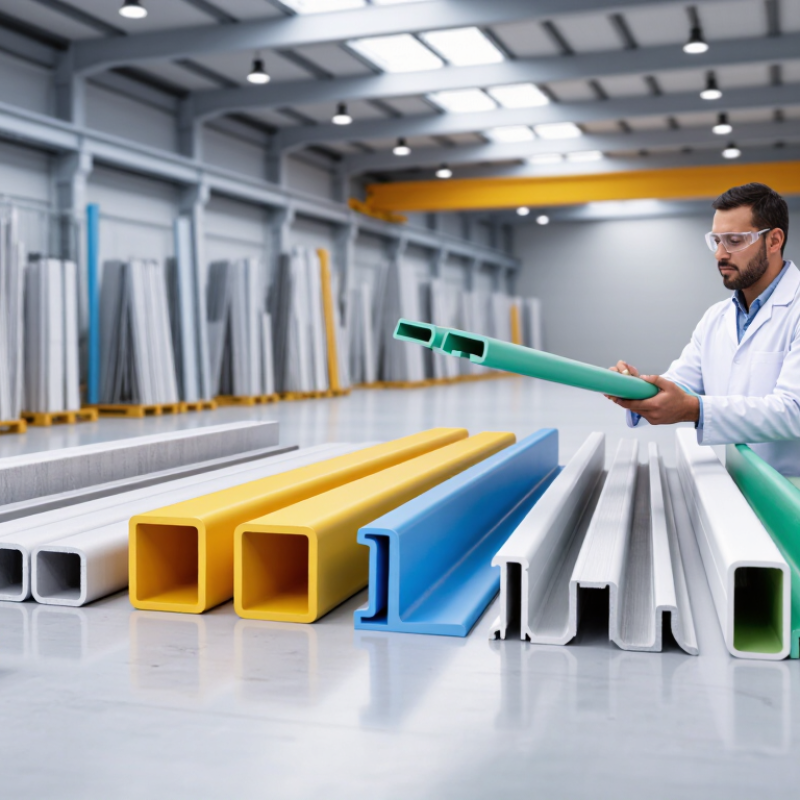
Define Insulating FRP Profiles and Their Main Applications
Insulating FRP profiles are structural shapes made from glass fibers and a polymer resin. The fibers provide strength, while the resin binds them into a rigid, electrically resistant section. Pultrusion commonly produces angles, channels, rods, tubes, and flat bars with consistent dimensions. Unlike steel, FRP does not readily conduct electricity or rust in wet environments. It is also lighter, which can simplify lifting and installation.
These profiles appear around switchgear, substations, cable supports, and electrical access platforms. They also serve as ladder rails, handrails, grating frames, and brackets in chemical plants and wastewater facilities. In practice, installers value the dry, non-sparking surface. However, “insulating” is not a complete safety rating. Moisture, contamination, surface damage, and voltage level can change performance. The finished assembly still needs proper clearance and testing.
Choosing a profile requires more than checking its shape. Review the resin system, glass-fiber direction, wall thickness, temperature range, UV exposure, and expected load. Fire behavior may matter indoors. Chemical compatibility matters near acids or solvents. I once focused too heavily on weight savings and overlooked bolt-hole stress. The profile worked, but the connection needed reinforcement. That mistake was avoidable. Cut edges should be sealed when recommended, and fasteners should not crush thin walls. Dimensional tolerances also deserve attention, especially where several profiles meet. Clear technical data and application-specific testing make the decision more reliable.
7 Tips for Choosing Insulating FRP Profiles
Define Insulating FRP Profiles and Their Main Applications
Insulating FRP profiles are pultruded fiber-reinforced polymer sections made from reinforcing fibers, commonly glass fibers, embedded in a resin matrix. They combine electrical insulation, corrosion resistance, low weight, and high mechanical strength. Typical applications include switchgear supports, busbar supports, transformer components, cable-tray structures, railway equipment, and industrial electrical enclosures.
How to use this chart: Match the profile’s resin system and operating environment with the required thermal class. The temperatures shown are maximum reference temperatures for thermal classes defined in IEC 60085; the actual continuous operating temperature of an FRP profile depends on its resin, fiber architecture, load, moisture, and design conditions.
Seven selection tips: define the electrical insulation level, check the required thermal class, evaluate mechanical loads, confirm corrosion and chemical resistance, consider moisture and UV exposure, select the correct profile geometry, and verify compliance with the relevant project standards and testing requirements.
Reference: IEC 60085, Electrical insulation — Thermal evaluation and designation.
Assess Electrical Insulation, Strength, and Safety Requirements
Choosing insulating FRP profiles begins with the electrical hazard, not the catalogue shape. Define operating voltage, transient exposure, clearance, and creepage distance. Dry laboratory resistance is not enough. Moisture, dust, and salt can create surface leakage. Request dielectric-strength data under conditions close to service. Confirm test methods, specimen thickness, and conditioning time. Otherwise, impressive figures may mislead.
Check mechanical demands beside insulation performance. Compare tensile, flexural, compression, and impact values at the actual temperature range. A support near a motor may face vibration, heat, and repeated loading. Ask for load-direction data, tolerances, and long-term creep results. Inspect cut edges and drilled holes; exposed fibers can weaken protection and irritate installers. Use suitable machining controls and seal exposed areas where the design requires it. I would not treat “nonconductive” as automatically safe.
Review fire behavior, smoke, tracking resistance, and chemical compatibility with the surrounding system. Verify conformity with applicable electrical and fire standards, and keep traceable test reports. During a design review, mark every contact point with metalwork and every possible water path. Small gaps matter. Include installation torque, fastener isolation, and inspection access in the specification. One practical weakness is relying on a single datasheet value; real assemblies rarely behave like flat test coupons. Recheck the profile after cutting, drilling, and exposure to heat or moisture.
Compare Material Types, Dimensions, and Environmental Resistance
7 Tips for Choosing Insulating FRP Profiles
Compare the resin before comparing the price. Polyester profiles suit dry, moderate conditions and usually offer economical electrical insulation. Vinyl ester performs better against moisture, acids, and solvents. Epoxy provides strong adhesion and dimensional stability, but it can cost more. According to ASTM D638 and D790 testing practices, suppliers should report tensile and flexural values, not vague claims such as “high strength.” Ask for glass content, resin type, and test temperature. Do not guess.
Check dimensions against the real load path. A thicker wall may improve stiffness, but it can also increase weight and drilling difficulty. Verify tolerances for width, thickness, straightness, and hole position. ASTM D3917 provides relevant dimensional guidance for pultruded profiles. In practice, a 2 mm mismatch can complicate a tight enclosure or create uneven clamping. Fit matters. Consider thermal expansion, especially where FRP meets steel, aluminum, or concrete.
Review environmental resistance using evidence, not marketing language. ISO 4892-3 supports accelerated UV exposure testing, while ASTM G154 helps evaluate weathering effects. Request retained strength and color data after exposure. For wet or coastal locations, check water absorption, salt spray behavior, and dielectric performance after conditioning. Some profiles survive years outdoors; others become chalky sooner than expected. I have seen designs overfocus on initial insulation and undercheck long-term moisture. That oversight deserves a second review. Use flame and smoke data tested under the project’s required standard, because “self-extinguishing” is not a universal classification.
Evaluate Manufacturing Quality, Standards, and Supplier Reliability
7 Tips for Choosing Insulating FRP Profiles
Evaluate Manufacturing Quality, Standards, and Supplier Reliability
A practical evaluation begins with the production floor, not a glossy catalog. Check glass-fiber alignment, resin wet-out, surface finish, and dimensional consistency. Request batch records, tensile results, and water-absorption data. ASTM D3917 provides useful dimensional guidance for pultruded profiles. Confirm testing follows relevant ASTM or IEC methods. Small voids can become visible failure points under vibration or moisture.
Ask whether the supplier controls resin mixing, pulling speed, curing temperature, and final inspection. ISO 9001 certification matters, but it does not guarantee every batch is perfect. The 2023 ISO Survey recorded more than one million ISO 9001 certificates worldwide. That scale shows quality systems are common, not automatically effective. Review nonconformance rates, corrective-action records, and calibration dates. A supplier unwilling to share evidence deserves caution.
Fire performance and electrical insulation require application-specific verification. Review IEC 60695 test results, dielectric strength, tracking resistance, and operating-temperature limits. NACE’s IMPACT study estimated global corrosion costs at 2.5 trillion dollars annually, or about 3.4% of global GDP. FRP can reduce corrosion exposure, yet poor installation may create new weaknesses. Compare samples from multiple production lots. Check lead times, backup tooling, packaging, and technical response times. Reliability is measurable. Do not ignore the uncomfortable question: can this supplier still support your profile five years later?
7 Tips for Choosing Insulating FRP Profiles - Evaluate Manufacturing Quality, Standards, and Supplier Reliability
| No. | Evaluation Dimension | What to Check | Practical Quality Indicator | Required Evidence | Priority |
| 1 | Define the Electrical Insulation Requirement | Confirm the working voltage, frequency, pollution level, humidity, clearance, and creepage requirements for the application. | The profile’s dielectric performance is suitable for the complete assembly, not only for a laboratory coupon. | Application specification, electrical test reports, and insulation coordination review based on IEC 60664-1 where applicable. | Critical |
| 2 | Verify the Reinforcement and Resin System | Review the glass-fiber type, reinforcement architecture, resin family, filler content, and fiber-volume consistency. | Continuous or well-oriented reinforcement provides dimensional stability and mechanical strength; the resin system matches the temperature and chemical environment. | Technical data sheet, material declaration, cross-section inspection, and batch-level raw-material traceability. | High |
| 3 | Assess Manufacturing Process Control | Check whether pultrusion or another forming process controls resin impregnation, curing temperature, pulling speed, die condition, and profile dimensions. | Stable dimensions, low visible porosity, consistent surface finish, and no cracks, dry spots, delamination, or resin-rich defects. | Process-control plan, inspection records, dimensional tolerances, photographs of cut sections, and nonconformance records. | High |
| 4 | Compare Relevant Standards and Test Methods | Match each claimed property with an appropriate test method rather than accepting a general “insulating” statement. | Electrical, mechanical, thermal, and flammability data are reported with test standards, specimen details, conditioning, and test dates. | Independent or accredited laboratory reports; examples may include IEC 60243-1 for electric strength and IEC 60695-11-10 for flammability testing when applicable. | Critical |
| 5 | Evaluate Thermal and Environmental Resistance | Consider continuous service temperature, short-term heat exposure, water absorption, UV radiation, chemicals, salt spray, and outdoor aging. | The chosen resin and surface finish retain insulation and mechanical properties after exposure conditions representative of actual service. | Temperature rating basis, accelerated-aging results, water-absorption data, UV or chemical-resistance reports, and defined service limits. | High |
| 6 | Confirm Dimensional and Mechanical Performance | Review tensile, flexural, compression, impact, creep, tolerance, straightness, and fastening performance for the intended load case. | Published values include test direction, specimen geometry, conditioning, and design safety factors instead of relying only on nominal strength. | Mechanical test reports, engineering drawings, tolerance tables, installation guidelines, and sample-fit verification. | High |
| 7 | Audit Supplier Reliability and Traceability | Assess quality-management practices, lead-time consistency, change notification, complaint handling, capacity, packaging, and long-term support. | The supplier can reproduce the approved profile, identify production batches, control changes, and provide consistent delivery documentation. | Quality certificate such as ISO 9001 where applicable, audit findings, batch certificates, corrective-action records, sample approval, and continuity plan. | Essential |
Note: Applicable standards and acceptance limits should be selected according to the end-use equipment, voltage level, environmental conditions, and relevant legal or customer specifications.
Select the Best Profile Through Testing, Cost, and Lifecycle Analysis
Choosing an insulating FRP profile should begin with evidence, not appearance. A smooth surface and clean cut do not prove reliable performance. Define the load, span, temperature range, moisture exposure, and electrical requirements before comparing profiles. Experienced engineers also check tolerances, resin quality, fiber direction, and connection details. Small design assumptions can create large field problems.
Testing should reflect the real installation. Request mechanical tests for bending, compression, impact, and long-term creep. Add electrical insulation tests after moisture and temperature conditioning. For outdoor use, examine ultraviolet exposure and surface degradation. A profile that performs well in a dry laboratory may behave differently beside a vibrating machine or wet enclosure. Test results need clear methods, sample sizes, and acceptance limits. Vague certificates are not enough.
Cost analysis must include more than the purchase price. Compare cutting waste, fasteners, labor time, transport weight, replacement access, and inspection needs. A slightly higher initial cost may reduce corrosion repairs over ten years. Build a lifecycle estimate with realistic service intervals and failure consequences. Keep assumptions visible. They are often wrong. Recheck them with maintenance staff and installers, who notice details design teams can miss. The best choice balances verified performance, practical installation, and predictable ownership costs.