
Choosing among the top 10 Voltage Instrument options starts with a practical question: what do you need to measure, and where? A handheld digital multimeter suits quick checks at a service bench. A bench meter offers stable readings for repeated tests. An oscilloscope reveals changing signals, while a high-voltage probe helps extend measurement range when used with compatible equipment. These tools are not interchangeable. Small details matter.
Measurement pioneer Lord Kelvin wrote, “When you can measure what you are speaking about, and express it in numbers, you know something about it.” His point still resonates with buyers. A useful instrument should provide readings that fit the task, with clear accuracy specifications, suitable input limits, and dependable documentation. Think about the workbench: crowded wiring, a small display, and readings that must be recorded later. A data logger may help there. For a quick check of whether a conductor is energized, a non-contact voltage detector can be useful, but it does not provide a precise voltage reading.
This guide compares ten common choices, including digital multimeters, voltmeters, oscilloscopes, voltage probes, testers, and calibrators. It considers measurement range, accuracy, safety features, usability, and cost. The best pick depends on the application, not a ranking alone. A polished specification sheet can still leave questions. Check the manual, verify instrument compatibility, and match the device to your measurement conditions before buying.
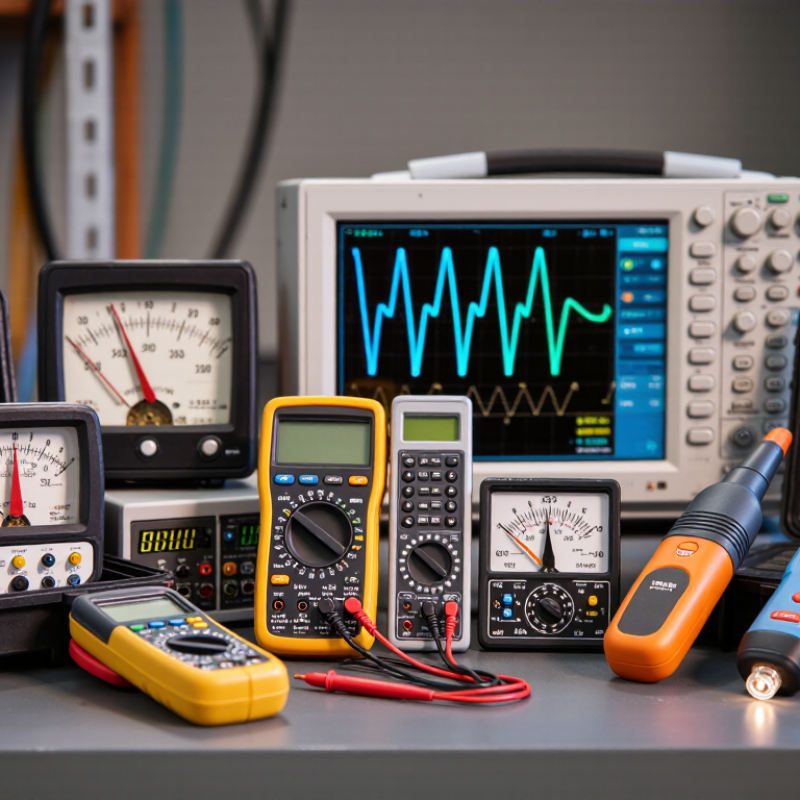
Voltage instruments are best classified by how they sense a signal and what decision the reading supports. An electrostatic voltmeter measures electric-field force, making it useful for high-voltage circuits with minimal loading. A moving-coil meter responds to direct current; a rectifier-type meter converts alternating current for display. An electrodynamometer uses interacting magnetic fields to measure AC or DC. Simple, but frequency response can matter.
Digital multimeters use analogue-to-digital conversion for routine voltage checks. Sampling voltmeters capture fast waveforms, while differential probes compare two points without grounding either one. Resistive or capacitive voltage dividers scale high voltages for safer measurement. Non-contact capacitive detectors provide quick presence checks, not dependable numeric readings. Power-quality analyzers sample voltage to reveal dips, swells, and harmonics. IEC 61000-4-30 defines Class A and Class S methods for power-quality measurement; the class affects comparability.
Grand View Research estimated the global test-and-measurement equipment market at USD 33.6 billion in 2023, reflecting broad demand across industrial measurement, not voltage meters alone. Buyers should match range, frequency, input impedance, and safety category to the circuit. A high reading is not automatically a better reading. The categories can overlap, and specifications may hide practical limits; checking calibration and probe ratings is easy to overlook.
A buyer’s ten-tool shortlist can include digital, analog, and bench multimeters; clamp meters with voltage measurement; handheld and panel voltmeters; non-contact voltage testers; two-pole testers; solenoid testers; and phase-sequence testers. They are not interchangeable. A digital multimeter suits mixed AC and DC checks, while a panel voltmeter gives a fixed, continuous reading. Non-contact testers are quick for initial screening, but they do not confirm a circuit is safely de-energized.
Compare each instrument’s AC and DC ranges with the expected source, not just its maximum voltage. For variable-speed drives or distorted waveforms, true-RMS measurement can give a more useful AC reading than average-responding meters. Check resolution, input impedance, and measurement category too. IEC 61010 defines safety requirements for electrical test equipment; the right category depends on where measurements occur. A meter’s display range alone says little about its suitability.
The stakes are practical: the U.S. Bureau of Labor Statistics reported 145 fatal workplace injuries involving exposure to electricity in its 2022 Census of Fatal Occupational Injuries. A properly rated meter and sound test procedure matter. A non-contact tester can miss shielded or low-voltage conductors. And an extra decimal place can be false comfort. Buyers should compare specifications against the actual panel, outlet, or battery circuit—and verify the instrument on a known source before and after testing.
Selecting voltage instruments starts with the signal, not the screen size. Match oscilloscope bandwidth to the fastest edge you need to inspect. A slow probe can erase detail, even when the scope has ample bandwidth. Check the probe’s attenuation, bandwidth, and maximum input voltage together. The full measurement chain matters.
Input limits are easy to misread. A probe marked 10:1 reduces the voltage at the scope, but it does not make every signal safe to measure. Confirm the probe’s rated voltage and the oscilloscope’s input limit, including peak values and frequency-related limits. For differential probes, check common-mode voltage as well as differential range. Small details matter. I would verify the manual rather than trust a familiar connector or setting; that extra check can feel tedious, but guessing is worse.
For measurements near electrical distribution equipment, match the instrument and probe CAT rating to the measurement location and voltage. A CAT rating addresses transient environments; it is not a substitute for checking the stated voltage limit. Inspect leads and insulation before use, and keep fingers behind probe guards. If the rating is unclear, stop and confirm it. That is not enough. Use instruments designed for the actual environment, and do not treat a bench scope as automatically suitable for every circuit.
Compare common oscilloscope bandwidth options when matching an instrument to a probe. These are bandwidth tiers, not rankings or guaranteed specifications for every model.
How to choose: Select scope and probe bandwidths appropriate for the signal’s fastest edge; the combined measurement system can have less bandwidth than either component alone. Separately verify the probe’s maximum input voltage, attenuation setting, and measurement category (CAT) rating for the circuit and measurement location. Bandwidth does not indicate voltage or CAT safety, and ratings vary by model.
For buyers comparing voltage instruments, insulation resistance and hipot testers deserve a close safety review. IEC 61010-2-034:2017 addresses equipment designed for insulation-resistance and electrical-strength testing. Check that the instrument’s stated functions and ratings match your test procedure, not just its maximum test voltage. A high output is not a safety rating.
IEC 61010-1:2010+A1:2016 distinguishes measurement categories by the electrical environment. Its impulse-voltage table lists 6 kV for CAT III at 600 V and 8 kV for CAT IV at 600 V. These figures describe transient withstand levels for measurement circuits; they do not automatically certify an insulation or hipot tester. Read the instrument’s specific rating, rated voltage to earth, and probe limitations. Labels matter.
On a bench, a tester may apply hundreds or thousands of volts to a disconnected cable, while its input terminals face a different hazard. Keep leads, guards, discharge functions, and interlocks in the assessment. Confirm that stored charge falls to a safe level before touching the specimen; do not assume the display means it is discharged. A small detail, but easy to miss. Standards define test conditions, yet the wrong setup can still produce misleading results. Check the applicable manual and calibration records, and document the selected test voltage and duration.
A useful shortlist starts with the job, not a ranking. For routine panel checks, consider a handheld digital multimeter, a voltage tester, or a clamp meter with voltage measurement. Bench multimeters suit controlled work where stable readings and finer resolution matter. For troubleshooting, an oscilloscope can reveal changing waveforms, while a power quality analyzer captures dips and harmonics. Different tools answer different questions.
For insulation checks, choose an insulation resistance tester; for longer-term monitoring, consider a voltage data logger. A high-voltage probe can extend an oscilloscope’s measurement range, but only when matched to its instrument. Add a non-contact detector for quick screening, not as proof of a safe circuit. That distinction matters. For work in CAT III 600 V environments, check the instrument’s marked rating, measurement category, voltage limit, and supplied leads together. A CAT rating on one component does not certify the whole setup. Accuracy should fit the task: a few digits may be enough for presence checks, while calibration and stated uncertainty matter for comparison or trending. I would not choose by display resolution alone; it can look impressive and still mislead. Verify the manual, inspect leads before use, and have qualified personnel confirm the instrument suits the installation.
| # | Instrument type | Best suited to | Typical voltage accuracy or indication | CAT III 600 V suitability | Buyer check |
|---|---|---|---|---|---|
| 1 | General-purpose handheld digital multimeter | Routine AC/DC voltage checks, troubleshooting, and electrical maintenance | Commonly around ±(0.5% of reading + 2 counts) on a DC voltage range; varies by range and instrument | Suitable only when the instrument and leads are explicitly rated at least CAT III 600 V | Check the category and voltage rating for both meter and leads, plus the input protection and fuse ratings. |
| 2 | True-RMS handheld multimeter | AC measurements on distorted or non-sinusoidal waveforms, such as those around variable-speed drives | Often around ±(0.5%–1.0% of reading + a few counts) for AC voltage; frequency and crest factor affect performance | Many models are available with CAT III 600 V ratings; confirm the exact instrument and lead markings | Check the stated AC bandwidth and crest-factor limits, especially for non-sinusoidal signals. |
| 3 | Voltage-measuring clamp meter | Voltage checks alongside current measurements where opening a circuit is undesirable | Typically around ±(1% of reading + several counts) for voltage, depending on range and AC/DC function | Some models meet CAT III 600 V; verify the rating applies to voltage inputs as well as the clamp’s intended use | Confirm voltage-input ratings separately from current-clamp specifications. |
| 4 | Two-pole voltage tester | Quick presence/absence checks and basic verification on installation circuits | Usually provides threshold-based or stepped indication rather than precision measurement accuracy | Commonly available with CAT III 600 V ratings, but the specific device and leads must be marked accordingly | Check the indication thresholds, operating method, and whether the tester supports a proving unit or other function check. |
| 5 | Non-contact voltage detector | Preliminary screening for the presence of AC electric fields without contacting a conductor | No dependable numerical voltage accuracy; detection depends on field strength, distance, insulation, and surroundings | A CAT marking, if present, does not make it a substitute for a contact tester or prove a circuit is de-energized | Use only as a preliminary indicator. Confirm absence of voltage with an appropriately rated contact instrument. |
| 6 | Bench digital multimeter | Laboratory, production, and service-bench measurements where stable, repeatable readings are important | Basic DC voltage accuracy can be around ±0.01% to ±0.1% of reading, depending on range, calibration, and specifications | Often not intended for CAT III 600 V field work; many bench instruments have lower measurement-category ratings | Do not infer a CAT rating from voltage range alone. Check the measurement-category marking and installation instructions. |
| 7 | Insulation resistance tester with voltage-measurement function | Insulation testing and related checks on cables, motors, and electrical equipment | Voltage-measurement accuracy is commonly less precise than that of a dedicated multimeter; consult the specified range and accuracy | Varies by model and function; verify the CAT rating for live-voltage measurement and the test leads | Keep insulation-test output specifications distinct from the instrument’s live-voltage measurement rating. |
| 8 | Power quality analyzer | Logging voltage trends, sags, swells, harmonics, and other power-system events | Voltage accuracy commonly falls in the approximate ±0.1%–0.5% range under specified conditions; harmonic performance has separate limits | Some analyzers and accessories are rated CAT III 600 V; confirm the rating of every input, probe, and lead used | Check sampling, logging duration, harmonic range, channel configuration, and accessory category ratings. |
| 9 | Process voltage calibrator or source-measure instrument | Generating or measuring low-level DC voltage signals for control-system testing and calibration | Often specified in the range of ±0.02%–0.1% of reading, with additional counts or range-dependent limits | Usually intended for control-panel or bench circuits, not automatically suitable for CAT III 600 V circuits | Check whether the device sources, measures, or both, and keep its terminal rating within the intended circuit category. |
| 10 | High-voltage differential probe with compatible meter or oscilloscope | Observing voltage waveforms between two points where neither point is safely at ground potential | Accuracy is probe- and frequency-dependent; attenuation ratio, bandwidth, and common-mode limits affect results | Only suitable where the probe’s explicit category and working-voltage ratings cover the measurement; the connected instrument must also be suitable | Check differential and common-mode ratings, transient limits, bandwidth, and the safety rating of the complete measurement setup. |
"*" indicates required fields