
Learn more about how Trevisan’s Horizontal Machining Centers can help you minimize set up time and labor costs.

What Are the Top Construction Aluminum Profiles in China?

China’s construction market uses aluminum profiles across homes, offices, factories, and public buildings. Construction Aluminum Profiles are not one product category. They include window and door frames, curtain-wall sections, thermal-break systems, and structural shapes for specialized projects. Each serves a different purpose. Some prioritize insulation and weather resistance; others need strength, low weight, or clean sightlines.

A useful comparison looks beyond appearance. Alloy grade, wall thickness, surface finish, dimensional accuracy, and compatibility with hardware can affect performance and installation. For example, a thermal-break window profile uses an insulating barrier between inner and outer aluminum sections. A curtain-wall mullion may instead need to support glass loads across a large façade. Details matter. A polished sample cannot prove long-term performance by itself.

This guide examines commonly used profile types and the factors that help buyers assess them in China. It considers applications, manufacturing quality, finishes, and supplier documentation, while recognizing that “top” depends on project requirements. A profile suited to a coastal apartment may not fit an inland industrial building. Specification sheets and test records are worth checking, though they do not answer every question. It is easy to focus on price and overlook installation conditions. That deserves a second look. The aim is a practical starting point, not a universal ranking.
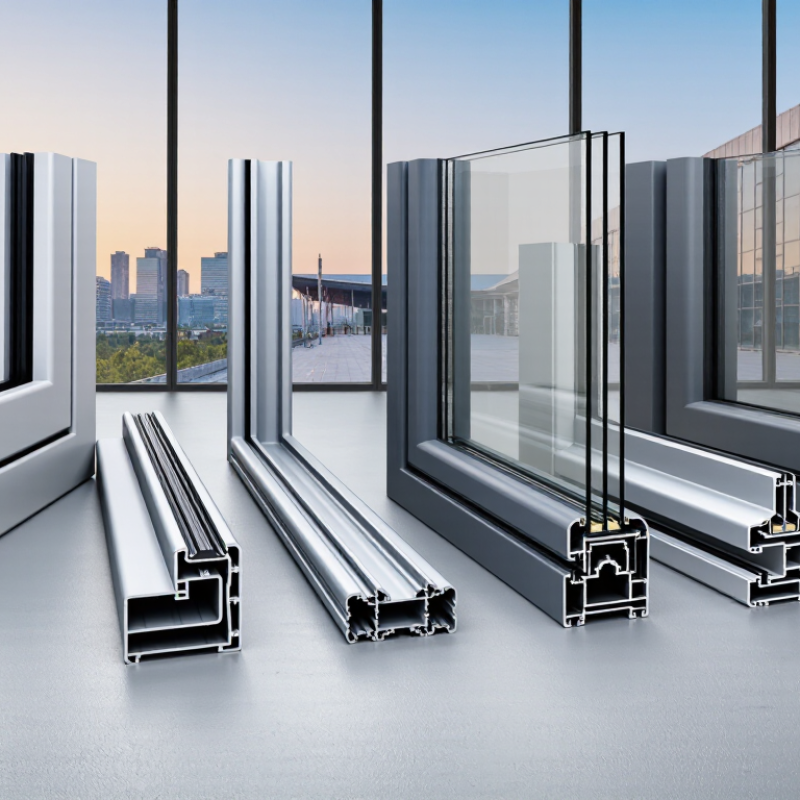
What Are the Top Construction Aluminum Profiles in China?

What Construction Aluminum Profiles Are and How They Are Used

Construction aluminium profiles are extruded shapes used to make building components. In China, common types include window and door frames, curtain-wall mullions and transoms, and structural sections. Their hollow chambers can reduce weight while providing routes for drainage, fasteners, or reinforcement. A curtain-wall mullion, for example, carries glass loads between floors; a window frame holds glazing and supports seals against rain and drafts.

The International Aluminium Institute reports that building and construction accounts for about one-quarter of global aluminium demand. That scale reflects aluminium’s light weight, corrosion resistance, and ability to form precise, repeatable shapes. For projects, the profile’s alloy, wall thickness, temper, and surface finish matter as much as its shape. Thermal-break profiles add an insulating barrier between inner and outer sections, helping limit heat transfer. Yet performance depends on the whole assembly, including glazing, seals, drainage, and installation. A good-looking section can still leak. That detail is easy to underestimate.

Tips: Check section drawings, load requirements, and thermal-break details before comparing quotes. Ask for test data tied to the proposed system, not just a sample profile. A small mock-up can reveal fit and sealing issues early.

Main Types of Aluminum Profiles for Building Projects

Construction aluminum profiles serve different jobs across a building envelope. Curtain-wall mullions and transoms carry glazing loads while allowing controlled drainage. Window and door profiles use multiple chambers to improve stiffness and limit heat transfer. Thermal-break systems add an insulating strip between interior and exterior aluminum sections. For roofs, partitions, and sunshades, lighter extrusions can simplify installation, but their dimensions still need project-specific checking.

The International Aluminium Institute’s 2023 global aluminium-cycle data indicate that building and construction account for roughly one-quarter of aluminum demand. This helps explain the sector’s broad profile range, but it does not prove that one section suits every climate or façade. Specify alloy, temper, wall thickness, finish, and connection details against structural calculations and exposure conditions. A slim profile may look elegant. It may also flex too much if spans or wind loads are underestimated.

Tips: Ask for section drawings, alloy and temper records, and coating specifications before approval. Check drainage paths at corners, not just on straight samples. One practical caution: catalogue dimensions can appear precise, yet site tolerances and installation quality still matter. I would treat thermal performance figures as design inputs, not guarantees; glazing, seals, and workmanship can change the final result.

Leading Construction Aluminum Profile Manufacturers in China

China’s leading construction aluminum profile manufacturers are best judged by process control, not factory size alone. Strong suppliers manage alloy selection, billet heating, extrusion speed, quenching, and aging as one production chain. This matters when a long window frame must stay straight across a wide opening. Guangdong, Shandong, and Jiangsu host major manufacturing clusters, but location alone cannot confirm quality.

China’s 2023 Statistical Communiqué records primary aluminum production of 41.59 million tonnes, showing the scale of the country’s upstream supply. That figure does not prove profile quality. Buyers should review test records against the GB/T 5237 series, check coating thickness, dimensional tolerances, and thermal-break bonding, and ask for samples from the actual production line. A polished showroom piece is not enough. Installation conditions can expose weaknesses that laboratory checks miss.

Tips: Compare section drawings, alloy and temper certificates, surface-treatment reports, and packaging details. Check whether profiles arrive with corner protection and clear batch identification. A lower quote may reflect thinner walls or fewer tests, though not always. No checklist catches every site issue; record the first delivered batch carefully before approving volume orders.

What Are the Top Construction Aluminum Profiles in China? - Leading Construction Aluminum Profile Manufacturers in China

Common construction aluminum profile categories used in China. These are product types, not a ranked list of manufacturers or brands.

Profile category Common alloy and temper Typical design features Typical building applications Common surface treatment
Window and door frame and sash profiles 6063-T5 or 6063-T6 Hollow, multi-chamber extrusions designed to form frame, sash, and glazing components. Residential and commercial windows and doors Powder coating, anodizing, or electrophoretic coating
Thermal-break window and door profiles 6063-T5 or 6063-T6 aluminum sections; commonly paired with polyamide insulating strips Separated interior and exterior aluminum sections reduce heat transfer through the frame. System performance depends on the full assembly and installation. Energy-conscious building windows and doors Powder coating, anodizing, or electrophoretic coating
Curtain wall mullion and transom profiles Commonly 6063-T5 or 6063-T6; alloy and temper depend on structural design Extruded framing members sized to support glazing and transfer project-specific loads to the building structure. Unitized and stick-built curtain wall façades Powder coating, anodizing, or fluorocarbon coating
Structural and heavy-duty profiles 6061-T6 or other specified structural alloys; selection depends on engineering requirements Custom solid or hollow sections designed for specified loads, connections, and service conditions. Canopies, supports, frames, and other building components Anodizing or coating specified for the application
Sunshade, louver, and ventilation profiles Often 6063-T5 or 6063-T6 Blade and support sections can be designed for shading, screening, or airflow; dimensions and angles vary by system. Façade shading, screens, and ventilation assemblies Powder coating or anodizing
Balustrade and railing profiles Commonly 6063-series alloys; temper and section depend on design loads Handrail, post, and infill-support sections must be selected as part of an engineered railing system. Balconies, stairs, terraces, and public areas Powder coating or anodizing
Decorative façade and trim profiles Often 6063-T5 or 6063-T6 Custom extruded shapes provide architectural lines or cover details; section geometry is project-specific. Façade trim, edge details, and interior architectural finishes Powder coating, anodizing, or fluorocarbon coating

Standards and selection: GB/T 5237 is China’s series of standards for wrought aluminum alloy building profiles, with parts covering topics such as base profiles and surface treatments. Confirm the applicable edition, alloy, temper, coating specification, dimensional tolerances, and project requirements with the supplier and design team. The alloy and finish examples above are common choices, not requirements for every application.

How Chinese Profiles Are Made and Quality-Checked

In China, construction aluminum profiles usually begin as alloy billets selected for strength, corrosion resistance, and intended use. Billets are heated and pushed through a shaped steel die, forming long sections with channels, grooves, and ribs. After extrusion, the profiles are cooled, stretched straight, and cut to length. Heat treatment may follow to achieve the specified temper. Small process changes matter.

Surface finishing varies by application. Anodizing creates a controlled oxide layer, while powder coating adds a colored protective finish. Quality checks often include profile dimensions, wall thickness, straightness, surface appearance, and coating thickness. Technicians may also test hardness and coating adhesion against project requirements. Batch records help connect inspection results to production details.

A careful factory check is useful, but it is not a guarantee of perfect performance. Even good inspections have limits. A gauge can confirm dimensions, but not whether a profile suits every installation detail. Buyers can request test reports and compare samples with approved drawings before production. For critical projects, independent testing may add confidence. Small scratches or color shifts can still appear, so acceptance criteria should be clear before delivery.

Choosing Profiles for Strength, Climate, and Project Needs

China’s construction aluminum profiles should be selected for load, exposure, and assembly details—not appearance alone. For curtain walls, roof framing, and window systems, check alloy and temper, wall thickness, section geometry, and connection design against project loads. A thick-looking extrusion is not automatically stronger. Not weight alone. Ask for test data and traceable material documentation, then confirm the system meets the relevant Chinese profile and project specifications.

Climate changes the choice. Coastal projects need durable surface protection, sound drainage, and carefully sealed joints; humid inland sites also benefit from preventing trapped water. In cold or hot regions, thermally broken frames can reduce heat transfer, but the full window assembly matters. UNEP and the Global Alliance for Buildings and Construction reported that buildings and construction accounted for 34% of global energy demand in 2022. Thermal performance is worth checking. The International Aluminium Institute reports that recycling aluminum uses about 95% less energy than primary production, but recycled content alone does not prove a profile’s strength or quality. A practical specification should balance verified performance, exposure, maintenance, and budget. Even then, drawings can miss site conditions; review drainage paths and joint details before installation.

Top Construction Aluminum Profiles in China: Strength by Alloy and Temper

Representative minimum yield-strength values for common extruded aluminum alloy tempers

6063 is widely used for architectural frames and general building profiles; T6 offers higher strength than T5. 6061-T6 and 6082-T6 are options for more demanding structural applications. Values are representative and can vary with governing standard, product form, and section thickness. Choose for the project’s loads and local climate, and specify suitable surface protection, drainage, and corrosion-resistant detailing where needed.

Scroll to Top
Scroll to Top