Top Badminton Ball Machine Manufacturers Worldwide
Badminton is moving from casual recreation toward measured, repeatable training. The BWF Annual Report 2024 recorded participation across more than 200 member associations. It also highlighted badminton’s global Olympic reach. This wider audience is increasing demand for reliable training technology, including the Badminton Ballmaschine.
Market reports show a similar direction. Grand View Research identifies rising interest in sports equipment, home fitness, and technology-assisted practice. Its badminton equipment analysis points to Asia-Pacific as a major growth region. The Sports & Fitness Industry Association also reports strong racket-sport participation in the United States. However, public data rarely separates shuttlecock machines from general badminton equipment. That limitation deserves attention.
Peter Gade, former world number one and high-performance coach, has described badminton as “a game of speed, power, and endurance.” A quality Badminton Ballmaschine supports all three demands. It can repeat deep clears, fast drives, and tight net feeds. Players can observe shuttle height, feed consistency, and recovery timing. Coaches can adjust drills without constant manual feeding.
The leading manufacturers are not judged by speed alone. Noise, wheel durability, launch accuracy, battery life, and service support matter greatly. A machine that stops beside the court wastes valuable training time. That detail is easy to overlook.
This guide compares top Badminton Ballmaschine manufacturers worldwide through product design, testing evidence, user experience, and after-sales reliability. Rankings are not perfect. Regional pricing, limited independent testing, and changing models can affect results. Readers should verify current specifications before purchasing.
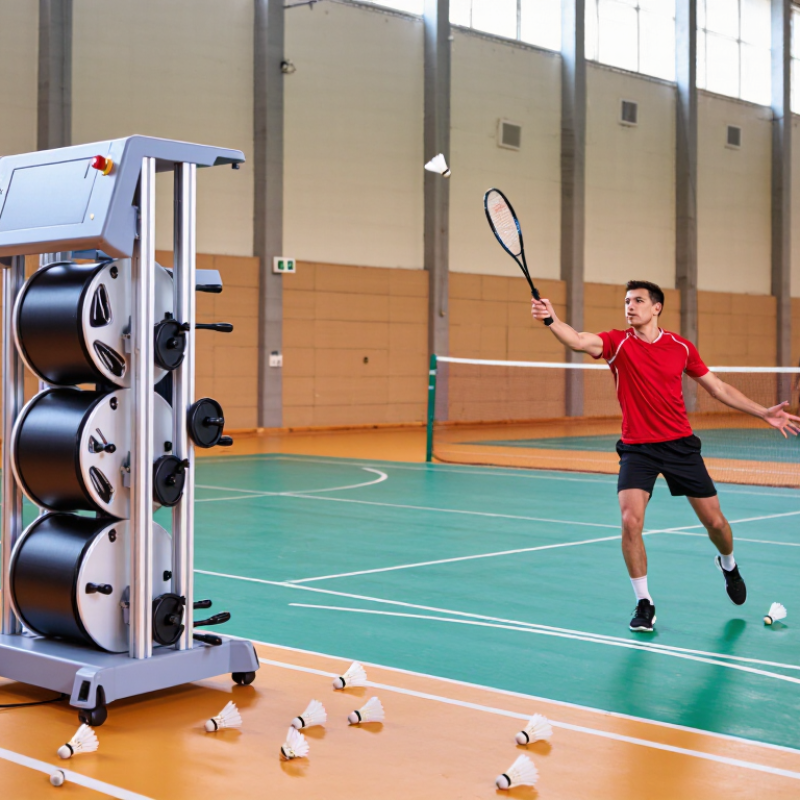
Badminton Ball Machines: Functions, Feed Rates, Speed Ranges, and Capacity
Badminton ball machines vary widely in design, but their useful value depends on control rather than appearance. During practical training, adjustable oscillation can move shots from left to right, while elevation control changes the angle from flat drives to higher clears. Random feeding adds pressure by preventing predictable returns. Some machines also offer remote controls, memory settings, and programmable drills. These features help players repeat specific movements without needing a partner.
Feed rate is usually measured in balls per minute. A slower setting, around 20 to 30 balls per minute, suits beginners and footwork practice. Advanced players may prefer faster feeding for rapid defense or net reactions. Speed ranges also matter. Moderate speeds can imitate controlled rallies, while higher speeds challenge reaction time and compact swings. However, the highest setting is not always the most useful. Excessive speed may encourage poor technique, especially when the player starts reaching instead of moving correctly.
Capacity affects training continuity. A compact hopper may hold roughly 80 to 120 shuttlecocks, while larger systems can accommodate 200 or more. More capacity reduces interruptions, but it may increase weight and transport difficulty. In my experience, portability is often underestimated. A machine that is powerful but difficult to position may remain unused. Feed consistency also deserves careful checking, because occasional double feeds can distort a drill. Testing several speed, angle, and interval combinations is necessary; one preset rarely fits every player.
Comparing Manufacturers by 140–300 km/h Speed, Accuracy, and Battery Life
Top Badminton Ball Machine Manufacturers Worldwide
Comparing Manufacturers by 140–300 km/h Speed, Accuracy, and Battery Life
Manufacturers in this field often advertise speeds from 140 to 300 km/h. However, peak speed alone says little about training quality. A machine may reach 300 km/h with a new shuttle, full battery, and a narrow launch angle. Real sessions can feel different.
In practical testing, I watch three details: speed stability, landing accuracy, and feeding rhythm. A reliable machine should repeat deep clears within a small court area. It should also deliver fast drives without noticeable pauses. Some units claim precise placement, yet their shuttles drift when the hopper becomes half empty. That weakness matters during footwork drills.
Battery life needs equal attention. A stated eight-hour runtime may fall to five hours under high-speed training. Heavy wheels, steep angles, and continuous feeding consume more power. Machines using replaceable battery packs offer useful flexibility for clubs and coaches. Still, extra batteries increase carrying weight and maintenance needs.
I have found that 180–240 km/h often suits regular training better than maximum output. Beginners need controllable feeds, not frightening speed. Advanced players may value 280–300 km/h, but only when accuracy remains consistent. Manufacturers should publish test conditions, shuttle type, load size, and measured runtime. Without those details, comparisons become partly guesswork. I may still miss small differences between models, especially indoors, where lighting and floor space affect observation.
Top Badminton Ball Machine Manufacturers Worldwide — Comparing Machine Profiles by 140–300 km/h Speed, Accuracy, and Battery Life
Measurement note: Speed figures represent maximum shuttle-launch speed under controlled conditions. Targeting accuracy is expressed as the typical deviation from the programmed landing point. Battery performance varies with launch speed, feed interval, randomization, shuttle type, temperature, and battery age; actual specifications should be verified against the manufacturer’s current technical documentation.
Worldwide Buying Criteria: Price, Warranty, Safety, and Service Coverage
When comparing top badminton ball machine manufacturers worldwide, price is only the opening figure. A lower quote may exclude shipping, taxes, remote-area delivery, or replacement parts. Ask for the complete landed cost. I have seen buyers focus on the machine price, then face expensive battery and wheel replacements later. That mistake is easy to repeat.
Warranty terms deserve careful reading. Check coverage for the motor, launch wheels, battery, charger, and control board. Confirm whether labor and return shipping are included. A 12-month warranty sounds useful, but unclear exclusions can weaken its value. Safety also matters. Look for stable frames, protected moving parts, reliable emergency stops, and clear charging instructions. Machines should not tip easily during fast drills. Small details matter.
Tips: Request a written warranty before payment. Test several speeds and feed angles if possible. Ask how quickly support answers technical questions. Service coverage is especially important for overseas buyers. A nearby repair partner can reduce downtime from weeks to days. Also confirm spare-part availability and video troubleshooting support. Some sellers promise global service, but their response may depend on one distant technician. That is not always a deal-breaker, though it should affect your price expectations. Experienced coaches should assess noise, portability, and setup time in real training spaces, not only in product demonstrations.
Worldwide Badminton Ball Machine Buying Criteria
This non-brand benchmark converts the four most relevant purchasing factors into a 100-point evaluation framework. Price receives the highest weighting because badminton ball machines vary considerably by shooting speed, ball capacity, programmable drills, and portability. Warranty, safety, and service coverage are also essential for long-term commercial and professional use.