
Top Magnetic Angle Sensor Manufacturers for Global Buyers
Choosing among the top Magnetic Angle Sensor manufacturers requires more than comparing prices or catalog numbers. Global buyers need dependable measurements, stable supply, and clear technical support. A sensor may sit inside a compact motor, steering system, robotic joint, or factory actuator. Its output must remain accurate despite vibration, temperature changes, electrical noise, and repeated rotation.
Magnetism is rarely simple.
Nobel-winning magnetism expert Professor Peter Grünberg once described giant magnetoresistance as “a completely unexpected effect.” That lesson still matters. Product performance can change when a sensor meets a real machine rather than a controlled laboratory setup. Therefore, this guide examines manufacturers through practical evidence, including sensing range, angular accuracy, linearity, response time, package design, automotive qualifications, and documented endurance testing. It also considers production capacity, regional distribution, customization, and after-sales engineering.
A strong supplier should provide more than a polished datasheet. Buyers should request test conditions, tolerance definitions, diagnostic features, and sample evaluation support. Independent certifications can strengthen confidence, but they do not replace application testing. No ranking is perfect. Manufacturing quality may vary between facilities, and an excellent device may still be unsuitable for a specific magnetic layout.
This overview is designed for engineers, sourcing teams, and equipment makers making international purchasing decisions. It compares established names with practical selection criteria, helping readers identify reliable partners without treating brand reputation as the only answer. The final choice should follow measured performance, transparent communication, and the realities of the intended application.
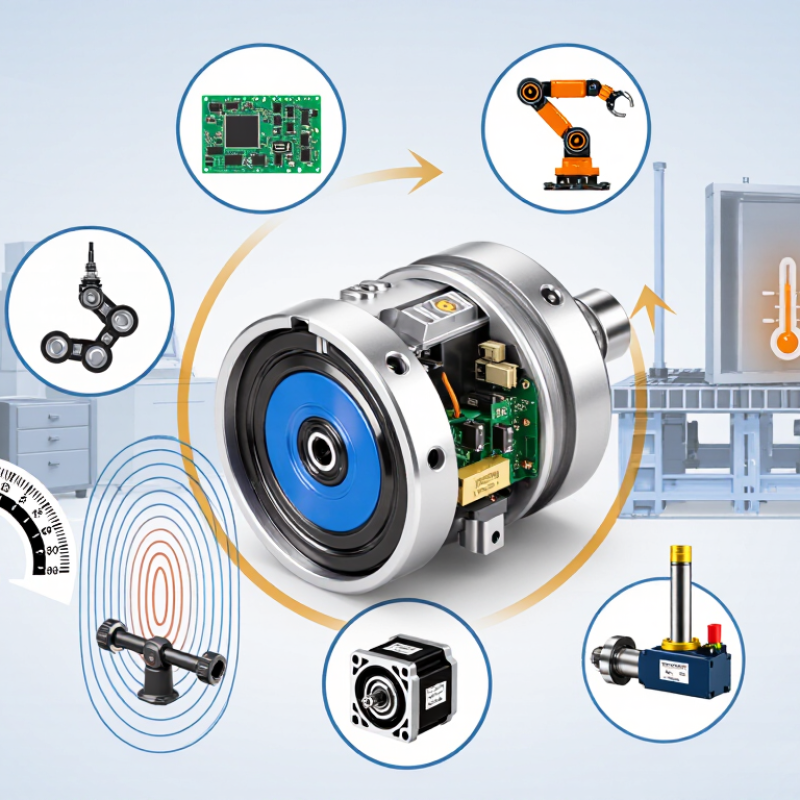
Table of Contents [Hide]
What Is a Magnetic Angle Sensor?
Top Magnetic Angle Sensor Manufacturers for Global Buyers
A magnetic angle sensor measures the rotational position of a shaft without physical contact. It detects changes in a magnetic field created by a small permanent magnet. Hall-effect, AMR, and TMR technologies are common sensing methods. The sensor converts field direction into an electrical signal, such as analog voltage, PWM, or digital data. This design reduces wear in steering systems, industrial actuators, robotics, and motor controls. No mechanical contact is needed.
Accuracy depends on magnet alignment, air gap, temperature, and nearby magnetic materials. A sensor may perform well in a laboratory, then drift inside a hot motor housing. That reality deserves attention. I have seen installation errors cause more trouble than the sensor itself. Engineers should check angular range, resolution, response time, and output compatibility before selecting a component. Shielding and calibration may also be necessary in electrically noisy equipment.
Tips: Keep the magnet centered over the sensing element. Follow the recommended air gap closely. Test the complete assembly across its real temperature range. Compare readings at several shaft speeds, not only at rest. A simple fixture can reveal alignment problems early. Also, leave room for adjustment; production tolerances are rarely perfect.
Top Magnetic Angle Sensor Manufacturers for Global Buyers - What Is a Magnetic Angle Sensor?
| Data Dimension | Technical Information | Typical Range or Standard | Buyer Relevance |
|---|---|---|---|
| Definition | A magnetic angle sensor measures the rotational position of a magnetic field, normally produced by a permanent magnet attached to a rotating shaft. | Non-contact angular measurement | Provides long operating life because the sensing element does not need mechanical contact with the rotating shaft. |
| Primary Sensing Technologies | Common technologies include Hall-effect, anisotropic magnetoresistance (AMR), giant magnetoresistance (GMR), and tunneling magnetoresistance (TMR). | Technology selection depends on accuracy, magnetic-field strength, speed, and cost requirements. | AMR, GMR, and TMR designs are often selected when higher sensitivity or improved angular performance is required. |
| Measurement Range | Magnetic angle sensors may measure a partial rotation or a full revolution by detecting the direction of a rotating magnetic field. | Common ranges include 90°, 180°, and 360° | Confirm whether the application requires limited-angle positioning or continuous full-turn measurement. |
| Magnet Configuration | A diametrically magnetized permanent magnet is frequently used for on-axis angle measurement. Off-axis configurations are also possible with suitable mechanical and magnetic design. | Magnet type, pole orientation, air gap, and alignment must be matched to the sensor. | Magnet-to-sensor alignment directly affects accuracy, linearity, and signal stability. |
| Output Interfaces | Available outputs can include analog voltage, differential sine/cosine signals, PWM, SENT, SPI, and other digital interfaces. | Interface choice depends on the control unit and system architecture. | Digital interfaces simplify calibration and diagnostics, while analog outputs can support simpler control systems. |
| Resolution | Digital angle sensors commonly specify resolution in bits, while analog devices are limited by signal quality, ADC performance, and electrical noise. | Typical digital resolutions are approximately 8 to 16 bits, depending on device class. | Higher resolution is useful for precise positioning, but it does not automatically guarantee higher absolute accuracy. |
| Angular Accuracy | Accuracy is influenced by sensor nonlinearity, magnet tolerances, air-gap variation, temperature, supply voltage, and calibration. | Application-level accuracy can range from below 1° to several degrees, depending on the complete mechanical and electrical design. | Compare total system accuracy rather than relying only on the sensor IC's nominal resolution. |
| Operating Temperature | Industrial and automotive magnetic angle sensors are available in different temperature grades. | Common ranges include approximately −40°C to +125°C; selected automotive devices may support temperatures up to +150°C. | Verify the full temperature range of the sensor, magnet, connector, and surrounding assembly. |
| Response Speed | Response speed depends on internal sampling rate, signal-processing bandwidth, interface speed, and the required accuracy. | High-speed variants are available for motor commutation, robotics, and dynamic position control. | Check maximum rotational speed, update rate, propagation delay, and latency under the intended operating conditions. |
| Supply Voltage | Magnetic angle sensors are commonly designed for low-voltage electronic systems. | Typical supply options include 3.3 V and 5 V; automotive products may support a wider regulated supply range. | Ensure compatibility with the controller, voltage regulation, transient protection, and electrical noise conditions. |
| Mechanical Installation | Important installation factors include axial and radial offset, air gap, shaft runout, magnet centering, and sensor-to-magnet orientation. | Permitted tolerances vary by sensor and magnet design. | Mechanical tolerance data should be reviewed before selecting a supplier or final package. |
| Common Applications | Typical applications include motor commutation, valve position feedback, steering and pedal position sensing, robotics, industrial actuators, and rotary controls. | Application requirements vary by industry and safety level. | Choose a sensor according to required reliability, diagnostic capability, environmental resistance, and certification needs. |
| Environmental Protection | Packaged sensors may be offered in sealed housings or surface-mount packages designed for protection against moisture, dust, vibration, and chemical exposure. | Protection ratings and qualification levels differ by package and application. | Review IP rating, vibration testing, humidity resistance, chemical compatibility, and connector sealing where applicable. |
| Safety and Reliability | Some devices provide diagnostics such as signal plausibility checks, internal fault detection, redundant channels, or error reporting. | Safety features are product-specific and may support industrial or automotive functional-safety designs. | For safety-related systems, request failure-mode data, diagnostic coverage, qualification reports, and relevant compliance documentation. |
| Selection Criteria for Global Buyers | Key comparison factors include sensing technology, measurement range, accuracy, resolution, output interface, temperature grade, package, supply stability, documentation, and sample availability. | Specifications should be compared using consistent test conditions. | Request datasheets, evaluation samples, application notes, quality certifications, lifecycle information, and production lead times before approval. |
Technical values shown above are general industry reference ranges rather than specifications for any particular manufacturer or product. Final performance depends on the complete sensor, magnet, mechanical assembly, electronics, calibration method, and operating environment.