
For global buyers, choosing Tree Lights involves more than comparing brightness, price, and appearance. A product that looks charming in a showroom may create glare across a hotel courtyard or fail during a rainy winter installation. Buyers must examine light source, cable quality, voltage options, control systems, weather resistance, packaging, and replacement support.
Lighting artist James Turrell has said, “Light is not so much something that reveals, as it is itself the revelation.” His observation suits modern Tree Lights, where illumination becomes part of the landscape rather than a simple accessory. Warm white string lights can create a quiet garden atmosphere, while curtain lights, cluster lights, net lights, and programmable pixel systems produce stronger visual impact. Solar, battery-powered, low-voltage, and mains-powered designs serve very different locations. There is no universal winner.
This guide introduces ten practical types for international buyers. Each category has useful strengths and inconvenient limits. Micro LED strands suit delicate branches, but their fine wires may require careful handling. Icicle lights add seasonal character, yet they can appear crowded on dense trees. Commercial-grade festoon lights offer durability, although their heavier sockets need stronger support. Smart Tree Lights provide scheduling and color control, but software compatibility can become frustrating across regions.
Buyers should also question unclear claims. “Outdoor-rated” does not always explain long-term performance. Certifications, test reports, plug standards, and supplier communication matter. Small details matter more than expected. A well-lit tree should feel intentional, safe, and reliable, not merely bright.
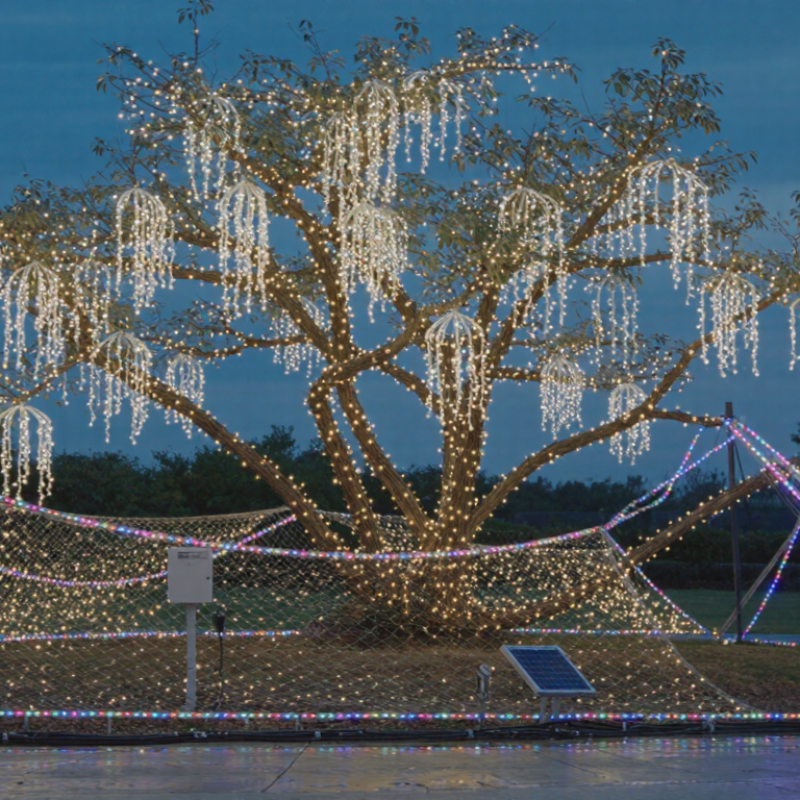
Tree lights are decorative lighting systems designed to outline branches, wrap trunks, or illuminate planted trees at night.
Their purpose combines visibility, seasonal atmosphere, landscape emphasis, and controlled outdoor decoration.
For global buyers, classification should begin with the light source: incandescent, LED, fiber optic, solar, battery-powered, smart, projection, curtain, net, and rope lights.
Technical classification matters more than appearance.
Buyers should check power input, voltage, cable length, color temperature, dimming method, and controller compatibility.
Outdoor models also need an ingress protection rating under IEC 60529. A higher IP rating usually offers stronger resistance to dust and water, but installation conditions still matter.
IEC 60598-2-20 is relevant to lighting chains, while local electrical rules may differ.
Energy data supports the shift toward LEDs.
The U.S. Department of Energy states that LED products use at least 75% less energy and last up to 25 times longer than incandescent lighting.
The International Energy Agency has reported that lighting consumes about 15% of global electricity.
These figures make efficiency a purchasing issue, not merely a design preference.
In practical testing, I would inspect connector sealing, wire flexibility, and heat around adapters. Small faults appear there first.
Classification can still feel imperfect, because one product may fit several categories. That is why buyers should compare both standards and real installation conditions.
Top 10 Types of Tree Lights for Global Buyers
Ten Tree Light Types by Form, Power Source, and Lighting Effect
Tree lighting choices become clearer when buyers separate form, power source, and visual effect. String lights create flexible outlines around trunks and branches. Curtain lights produce vertical falling points for large trees. Net lights cover dense foliage quickly. Cluster lights create a fuller, sparkling texture. Icicle lights add hanging, winter-like movement. Trunk-wrap lights emphasize bark and structure. Branch lights imitate glowing twigs. Projection lights cast patterns onto nearby surfaces. Solar stake lights suit gardens without fixed wiring. Battery micro lights work well for portable displays and small trees.
Power sources affect installation and operating cost. Mains-powered systems support longer runs but need careful outdoor protection. Solar systems reduce cable use, although winter weather can weaken charging performance. Battery models offer mobility, but frequent replacement can become wasteful. The U.S. Department of Energy reports that LEDs use at least 75% less energy than incandescent lighting and last up to 25 times longer. The International Energy Agency also estimates lighting consumes about 15% of global electricity.
Lighting effects deserve equal attention. Warm white supports hospitality settings, while cool white gives foliage sharper definition. Twinkle, flash, fade, and static modes create different emotional results. Check ingress protection ratings, cable length, timer functions, and replacement-part availability. A beautiful display can still disappoint when connectors are incompatible. I find color descriptions inconsistent across suppliers, so buyers should request sample photos and measured color temperature. Specification sheets help, but real branches remain the final test.
| No. | Tree Light Type | Form and Construction | Typical Power Source | Common Lighting Effect | Typical Application | Key Buying Consideration |
|---|---|---|---|---|---|---|
| 1 | String or Fairy Lights | A flexible insulated cable with evenly spaced LED bulbs, available in straight or connectable lengths. | Mains adapterLow-voltage adapterBattery | Steady illumination, twinkle, flashing, or color-changing effects. | Wrapping branches, trunks, railings, wreaths, and indoor decorative trees. | Check LED spacing, total cable length, timer settings, connector limits, and whether the adapter is suitable for the destination voltage. |
| 2 | Curtain Lights | A horizontal header cable with multiple vertical light strands hanging downward. | Mains adapterLow-voltage adapterUSB | Uniform curtain-like glow, cascading patterns, twinkle, or chasing sequences. | Large tree canopies, walls, windows, event backdrops, and vertical garden displays. | Compare overall width, drop length, strand density, hanging-point strength, and controller functions. |
| 3 | Icicle Lights | A horizontal cable fitted with vertical drops of different lengths to imitate hanging icicles. | Mains adapterLow-voltage adapter | Steady white light, twinkle, or staggered chasing effects. | Tree edges, rooflines, branches, fences, and seasonal outdoor displays. | Verify drop-length pattern, cable support, outdoor suitability, and whether multiple sets can be safely connected. |
| 4 | Net Lights | A pre-spaced grid of lights designed to drape over a surface or wrap around branches. | Mains adapterLow-voltage adapterSolar | Even coverage, steady glow, twinkle, or flashing patterns. | Small trees, shrubs, hedges, bushes, and broad tree crowns. | Measure the mesh dimensions, grid spacing, edge cable length, and the shape of the target tree before purchasing. |
| 5 | Rope Lights | LEDs enclosed inside a flexible, continuous tube or flat protective casing. | MainsLow-voltageBattery | Continuous line of light, color-changing, chasing, or programmable effects, depending on the controller. | Tree trunks, large branches, outlines, walkways, and architectural landscaping. | Check bend radius, cut-mark spacing, end-cap sealing, heat dissipation, and the required mounting clips. |
| 6 | LED Strip Lights | A flexible printed circuit board carrying surface-mounted LEDs, usually with an adhesive backing or mounting channels. | DC adapterUSBBattery pack | Single-color, tunable white, RGB color mixing, dimming, or music-synchronized effects. | Hidden trunk accents, indoor display trees, shelves, planters, and controlled architectural lighting. | Choose an outdoor-rated encapsulation when exposed to moisture and match the power supply to the strip’s voltage and wattage. |
| 7 | Cluster Lights | Many short LED branches are attached to a main cable, creating a dense illuminated arrangement. | Mains adapterLow-voltage adapterBattery | Bright dense sparkle, twinkle, steady light, or multi-function flashing. | Full-looking artificial trees, dense foliage, trunks, wreaths, and high-impact seasonal displays. | Review bulb density, cable weight, heat management, storage requirements, and the controller’s memory function. |
| 8 | Projection Tree Lights | A separate projector or spotlight casts patterns, colors, or moving images onto trees and surrounding surfaces. | Mains adapterLow-voltage adapterBattery | Moving stars, seasonal motifs, color washes, rotating patterns, or static spot effects. | Large outdoor trees, façades, gardens, public displays, and temporary events. | Consider projection distance, coverage area, weather protection, mounting stability, brightness, and timer controls. |
| 9 | Solar-Powered Stake or Branch Lights | Small LED fixtures mounted on stakes or flexible decorative branches with an integrated solar panel and rechargeable battery. | Solar panelRechargeable battery | Usually steady, flickering flame-style, twinkle, or simple color-changing light. | Garden beds, pathways, tree bases, planters, and locations without a nearby electrical outlet. | Evaluate panel placement, daily sunlight, battery capacity, seasonal performance, and automatic dusk-to-dawn operation. |
| 10 | Trunk and Branch Wrap Lights | Compact low-voltage light sets, flexible bands, or preformed fixtures specifically arranged for tree trunks and branches. | Mains adapterLow-voltage transformerBattery | Continuous trunk outline, warm-white accent, steady light, or subtle twinkle. | Permanent or seasonal tree illumination in gardens, streetscapes, parks, entrances, and commercial landscapes. | Prioritize cable durability, safe attachment methods, expansion capability, low heat output, and protection against moisture. |
Buyer note: Outdoor suitability depends on the complete lighting system, including the light set, connectors, controller, adapter, and installation method. Check the product’s stated ingress-protection rating and local electrical requirements before installation.
Top 10 Types of Tree Lights for Global Buyers
Key Specifications for Comparing Tree Lights Across Global Markets
When comparing ten common tree-light designs, start with voltage, plug type, and frequency compatibility. A product made for one market may need a different adapter elsewhere. Check whether the input supports local electrical systems. Do not trust vague wording.
Light source affects both appearance and operating cost. LED bulbs usually produce less heat and use less energy than older alternatives. Compare color temperature, brightness, and color-rendering quality. Warm white suits indoor trees, while cooler tones can sharpen outdoor displays. Flashing modes should include stable memory settings.
Weather resistance needs careful attention. An IP44 rating may suit sheltered areas, but exposed branches often need stronger protection. Examine the controller, connector, cable insulation, and sealing points separately. The weakest part decides practical durability. I have seen attractive sets fail because water entered a small controller seam.
Measure total cable length, illuminated length, bulb spacing, and lead-wire length. These details prevent awkward gaps around tall trees. A timer, dimmer, and remote control can improve daily use, but controls should remain simple. Small buttons are frustrating with gloves.
Safety documentation matters across global markets. Ask for clear test reports, rated power, operating temperature, and material information. Packaging should protect wires from crushing and tangling. A long warranty helps, though it cannot replace reliable testing. Perfect comparisons are impossible. Regional installation habits still differ.
Representative rated service life by light type. Values are typical midpoint estimates based on commonly published specifications; actual performance varies by construction, operating temperature, power supply, and market certification requirements.
LED-based tree lights generally provide a substantially longer rated life than incandescent products. Buyers should also compare input voltage, ingress protection, replaceability, connector standards, color temperature, dimming control, and regional safety certification.
International buyers should assess more than brightness. LED strings, net lights, icicle lights, cluster lights, curtain lights, branch lights, rope lights, projection lights, battery lights, and solar lights face different risks. IEC 60598-2-20 covers decorative chain lights, while IEC 60529 defines IP protection ratings. An IP44 product resists splashing, but exposed gardens may need stronger protection. Local certification still matters. In the United States, buyers often request products evaluated against UL 588. In Europe, CE marking supports regulatory conformity, but it is not automatically independent certification.
Climate testing needs practical detail. Cold temperatures can make cable insulation brittle. Strong sunlight can weaken plastic housings. Humid regions need sealed connectors and clear drainage paths. The International Energy Agency reports that LED lamps use far less electricity than incandescent lighting, yet energy savings do not remove fire risks. NFPA’s Home Christmas Tree Fires report estimated 160 U.S. home fires annually from 2016 to 2020. This figure is small, but the consequences are serious. A certificate alone is not enough. Installation quality remains an uncomfortable weak point.
Tips:
Ask for test reports, plug specifications, IP evidence, UV testing, and temperature ranges. Check whether the adapter matches the destination country. Avoid connecting indoor-rated lights outdoors. Inspect cables after shipping. Small cracks matter. Seasonal packaging can also hide damage, so buyers should request sample testing before large orders. Requirements differ by country, and some product listings explain them too simply. Reflect before choosing the lowest price.
For global buyers, choosing among ten tree-light types starts with supplier evidence, not catalog photos. Ask for IEC 60598-2-20 test records, electrical safety reports, and production samples. The standard covers series-connected decorative lighting chains. Verify wire gauge, insulation, plug configuration, timer performance, and ingress protection. A supplier should also explain LED bin consistency and expected lumen maintenance. The U.S. Department of Energy’s LED Lighting Facts report shows that LED products commonly deliver much higher efficacy than older incandescent technologies. Yet decorative lighting often prioritizes appearance over efficiency. Request measured data for the exact model.
Packaging needs practical testing. Use molded separators or recycled pulp trays to prevent tangled wires, crushed sockets, and scratched coatings. ISTA 3A testing can simulate parcel handling, vibration, and repeated drops. A perfect carton is unrealistic. However, one damaged socket can increase returns quickly. Measure packed volume before negotiating prices. UNCTAD’s Review of Maritime Transport reports that maritime shipping carries over 80% of global merchandise trade by volume, making carton efficiency important for ocean freight. Confirm carton dimensions, gross weight, pallet limits, moisture barriers, and container loading plans. Small details matter.
Shipping documents should match the physical product. Provide accurate carton markings, product descriptions, quantities, and electrical specifications. For battery-powered or remote-controlled versions, check carrier requirements before booking. I would also request a pre-shipment inspection with random carton opening. It costs more, but supplier claims sometimes differ from production reality. Temperature, humidity, and long transit times can expose weak packaging. Do not test only one sample. Test the boring parts too.
"*" indicates required fields