
A steel light pole is a vertical structural support that carries luminaires, wiring, and related equipment above streets, parking areas, or public spaces. Its familiar silhouette can seem simple: a tapered shaft, a base plate, anchor bolts, and an arm reaching over the pavement. But each part must work together under real conditions, including wind, vibration, corrosion, and the weight of mounted equipment.
The design is more than a matter of choosing a height. Engineers consider the pole’s material grade, wall thickness, foundation, connections, and site-specific loading. The American Association of State Highway and Transportation Officials’ structural-support specifications address the design of supports for highway luminaires, signs, and traffic signals. The World Steel Association’s World Steel in Figures 2024 reports 1,892.2 million tonnes of crude steel production in 2023, illustrating the scale of the material supply behind infrastructure products. That figure describes steel production, not light poles, so it should not be mistaken for pole-market data.
A careful introduction should also distinguish verified quotations from marketing language. No source material was provided identifying a steel light pole expert or a verifiable quotation from one; inventing an attribution would weaken reliability. The practical takeaway is still clear: a steel light pole is an engineered support, not merely a post with a lamp. Its performance depends on sound specification, fabrication, installation, and inspection. Small details matter. A loose connection or poorly protected base can become the weak point.
What Is a Steel Light Pole?
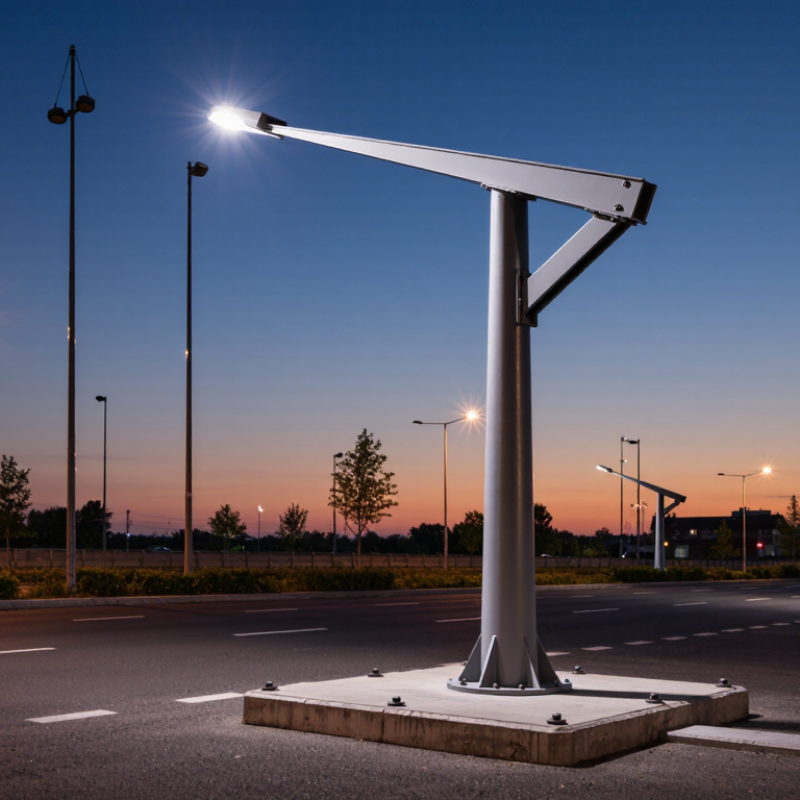
A steel light pole is a vertical structure that holds one or more outdoor light fixtures above the ground. Its purpose is to position light where people need visibility, such as along streets, parking areas, walkways, and industrial sites. The pole carries the fixture and may also route electrical wiring through its hollow interior. Simple job, but details matter. Height, arm length, and fixture weight affect how the pole handles wind and other loads.
A pole’s design must suit its location, foundation, and lighting layout. Engineers consider wind exposure, soil conditions, pole height, and the weight of attached equipment. At the base, a steel plate and anchor bolts connect the pole to a concrete foundation. Correct alignment matters; a small tilt can become noticeable across a row of poles. Protective coatings, such as galvanizing or suitable paint systems, help limit corrosion from rain and road salt. Still, no finish makes steel maintenance-free. Periodic checks can reveal damaged coatings, loose connections, or water entering the base. There is no single ideal pole. A practical choice balances structural needs, service access, appearance, and long-term upkeep.
A steel light pole is a structural assembly, not just a hollow shaft. Its main parts include a tapered steel pole, base plate, anchor bolts, handhole, wiring, and a mounting arm or luminaire connection. The shaft carries bending loads down to the base, while the plate and anchors transfer them into the concrete foundation. Small parts matter. A poorly fitted access cover, for example, can admit water and speed corrosion around internal wiring.
The shaft’s diameter, wall thickness, taper, and height work together to resist wind and equipment weight. AISC 360-22 specifies a steel elastic modulus of 29,000 ksi, about 200 GPa, a key value used in structural calculations. But that figure alone does not establish pole capacity. AASHTO’s LRFD specifications for structural supports require wind effects to reflect site conditions and the exposed area of the pole, arm, and luminaire. A broad fixture can create more wind demand than its weight suggests.
At the base, welds connect the shaft to the plate, and anchor bolts secure the assembly to its foundation. Designers also account for fatigue from repeated wind movement, corrosion protection, and access for inspection. Galvanized coatings are common, but coating quality and drainage details deserve attention; water trapped inside a pole can undermine an otherwise sound design. A practical review should check drawings, weld details, bolt layout, and the actual luminaire dimensions. One weak spot remains easy to overlook: field installation may differ from the tidy drawing.
Steel light poles are usually made from structural carbon steel, chosen for strength, weldability, and dependable outdoor service. Common options include ASTM A36 for general fabrication and ASTM A572 Grade 50 when a design requires higher yield strength. The right grade depends on pole height, wind exposure, fixture weight, and the engineer’s calculations. Stronger steel is not automatically the better choice.
Manufacturing begins with steel plate or sheet cut to size. The pieces are rolled into tapered sections, then joined with longitudinal welds. Workers inspect the welds and check dimensions before sections are assembled. Base plates and connection details are fitted to suit the installation design. Small details matter. A slight mismatch can complicate assembly later.
The finished pole may be galvanized by immersion in molten zinc, creating a protective coating on exposed surfaces and inside accessible areas. Coating thickness and coverage should be checked against the project specification. A smooth weld bead looks reassuring, but appearance alone cannot confirm weld quality. Inspection records, material certificates, and dimensional checks help verify consistency. In practice, handling and transport can still cause scratches, so protective packing and careful site storage deserve attention.
What Is a Steel Light Pole?
Common Types and Configurations
Steel light poles come in several shapes, each suited to different loads and site conditions. Round tapered poles narrow toward the top and offer a clean profile with few exposed edges. Octagonal poles have flat sides that make their shape easy to recognize and can simplify some mounting layouts. Square poles are less common for roadway lighting but may suit sites where a more angular appearance is preferred. The differences matter.
The arm configuration affects where light can be placed. A straight or curved davit arm typically supports one luminaire, while a double arm can serve two directions from one pole. High-mast poles use multiple luminaires mounted high above broad areas, such as large parking lots. Mounting also varies: anchor-base poles attach to a concrete foundation with anchor bolts, while direct-burial poles extend below grade. Each option brings trade-offs. For example, a longer arm changes the load on the pole, so pole height, wind exposure, fixture weight, and foundation design should be considered together. It is tempting to choose by appearance alone, but that can miss practical constraints. A careful site review helps match the pole configuration to clearance needs, soil conditions, and the intended lighting layout.
| Type or Configuration | Typical Construction | Common Arm or Mounting Setup | Common Applications | Key Considerations |
|---|---|---|---|---|
| Steel light pole | A vertical support made from structural steel, commonly formed as a tapered or straight shaft. | May use a bracket arm, davit arm, tenon, or direct-mounted luminaire, depending on the design. | Roads, streets, parking areas, campuses, and public spaces. | Height, wind loading, fixture weight, corrosion protection, and foundation design must suit the site. |
| Octagonal tapered pole | A faceted, typically eight-sided shaft that narrows toward the top. | Often supplied with a side-mounted arm, top-mounted tenon, or multiple arms. | Roadways, parking lots, and general outdoor area lighting. | The tapered shape and shaft design are selected to meet the required structural loads. |
| Round tapered pole | A circular shaft with a gradual reduction in diameter toward the top. | Commonly paired with a curved or straight arm, or a top-mounted fixture. | Streets, pathways, parks, and parking areas. | Check fixture orientation, arm reach, access needs, and compatibility with the pole top. |
| Straight round pole | A circular shaft with a largely uniform diameter along its length. | May use a bracket, tenon-mounted fixture, or purpose-designed multi-fixture assembly. | Walkways, small outdoor areas, and sites requiring a simple pole profile. | Structural capacity depends on the shaft, material thickness, connections, and site loads. |
| Square or rectangular pole | A straight or tapered shaft with a square or rectangular cross-section. | Typically uses a side-mounted bracket or a compatible top mounting arrangement. | Commercial properties, campuses, and architectural outdoor spaces. | Confirm mounting details and directional orientation during layout and installation planning. |
| Single-arm configuration | A pole fitted with one projecting arm. | One luminaire is mounted on the arm; arm length and angle vary by design. | Road edges, sidewalks, and perimeter lighting. | Arm projection affects fixture position and contributes to the structural load on the pole. |
| Double-arm configuration | A pole fitted with two arms, commonly arranged in opposite directions. | Two luminaires are mounted on separate arms. | Roadways, medians, and larger outdoor areas requiring light in more than one direction. | Both fixtures and arms must be included in the structural and foundation design. |
| Tenon-top configuration | A pole with a short vertical mounting section at the top, sized for compatible equipment. | Accepts a compatible luminaire or accessory designed for tenon mounting. | Area lighting and installations using top-mounted fixtures. | Verify the tenon dimensions and mounting method against the selected fixture requirements. |
| Anchor-base configuration | The pole is attached by a base plate and anchor bolts to a concrete foundation. | May support single-arm, double-arm, or top-mounted luminaires. | Many roadway, parking, and site-lighting installations. | Anchor-bolt layout, base plate, foundation, and access for installation must be coordinated. |
| Direct-burial configuration | The lower portion of the pole is embedded directly in the ground or in a prepared foundation. | Mounting options depend on the pole design and lighting layout. | Some roadway, pathway, and site-lighting applications. | Buried-section protection, soil conditions, drainage, and installation depth require attention. |
| High-mast system | A tall pole designed to support a group of luminaires at a single elevated mounting level. | Often uses a ring or frame carrying multiple fixtures; some systems allow lowering for maintenance. | Large interchanges, airports, ports, and expansive outdoor areas. | Requires site-specific structural design, foundation planning, and a safe maintenance strategy. |
Pole dimensions, mounting details, materials, and finishes vary by project. Final selection should be based on applicable codes, site conditions, wind loads, luminaire requirements, and foundation design.
What Is a Steel Light Pole?
Applications, Performance, and Maintenance
Steel light poles support lighting in parking lots, streets, campuses, and pedestrian areas. Their strength suits locations where fixtures face wind, vibration, or occasional impacts. Pole height and spacing affect both coverage and glare, so they should match the site layout. A galvanized or properly coated finish helps resist corrosion, especially near coastlines or where road salt is common. Details matter.
Performance depends on more than the pole’s material. The base plate, anchor bolts, soil, and fixture weight all affect stability. Engineers typically consider wind exposure and the complete assembly when selecting a pole. During service, watch for leaning, cracked coatings, loose hardware, or water collecting around the base. These signs can indicate problems, but appearance alone cannot confirm structural condition. A neat installation can still hide a weak foundation.
Tips: Keep the pole base clear of soil and standing water. Check bolts and visible coating damage during routine site inspections. Record changes with dated photos; small differences are easier to spot over time. Use qualified electrical personnel for wiring or fixture work. One detail is easy to miss: after repairs, verify that access panels are closed and seals are intact. Even careful maintenance has limits, so reassess poles after severe storms or vehicle impacts.
Typical Steel Light Pole Heights by Application
Steel poles are used for street, roadway, and sports-area lighting. Heights shown are indicative design ranges; the final pole height depends on lighting requirements, site conditions, and local standards. Routine inspections should check the pole, base, and protective coating for damage or corrosion.
"*" indicates required fields