
Why Choose a Lathe CNC Machine for Your Business?
Choosing a lathe cnc machine is a practical decision for businesses seeking controlled, repeatable turning operations. In a busy workshop, it can produce shafts, bushings, threads, and tapered components with consistent dimensions. Operators load a workpiece, secure the tooling, and follow a programmed cutting sequence. The result is tangible. Clean chips, stable cuts, and fewer manual adjustments can improve daily productivity.
A modern lathe cnc machine also supports detailed production planning. It can handle small batches, prototypes, and larger repeat orders when properly configured. Experienced machinists understand that accuracy depends on more than software. Tool condition, material hardness, workholding, coolant flow, and machine calibration all influence the final part. A reliable supplier should provide technical specifications, training options, service support, and clear information about tolerances. Independent reviews and documented testing can also help buyers compare models responsibly.
However, CNC automation is not a magic solution. Poor drawings, weak maintenance, or rushed programming can still create expensive mistakes. I have seen how a slightly misaligned chuck can mark a finished surface and delay delivery. That lesson is easy to overlook. Businesses should calculate tooling costs, operator training, floor space, energy use, and expected workload before purchasing. The most suitable machine is not always the largest or fastest model. It is the one that matches real production needs, supports safe working practices, and remains dependable after years of use. Careful evaluation builds confidence and protects the investment.
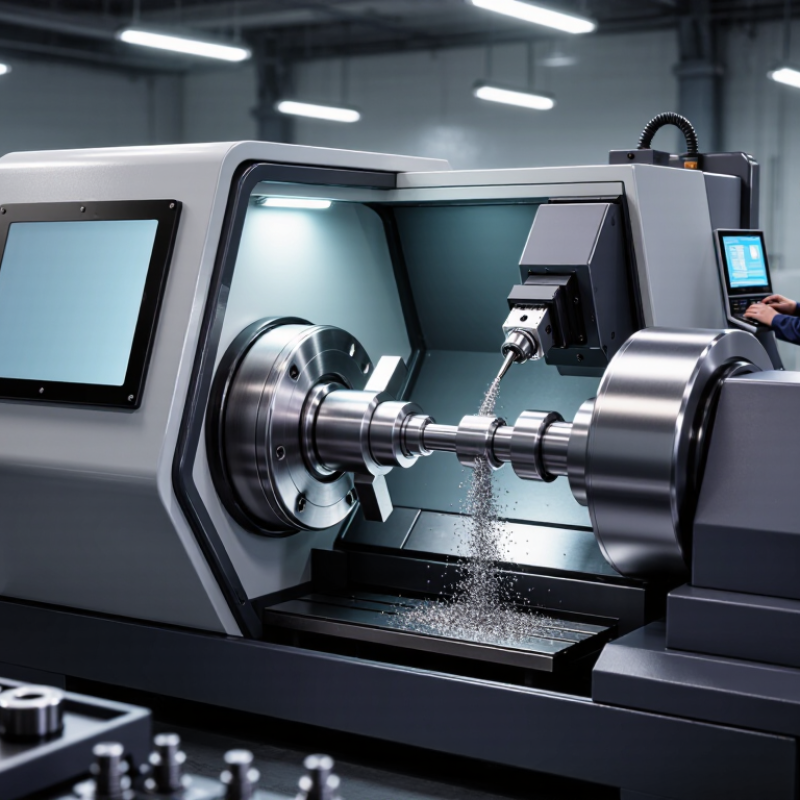
Table of Contents
[Hide]
What Is a Lathe CNC Machine and How Does It Work?
A lathe CNC machine is a computer-controlled turning system. It shapes material while the workpiece rotates around a fixed spindle axis. A chuck holds the bar or billet securely. Cutting tools then move across its surface. They create diameters, threads, grooves, tapers, and precise end faces.
The operator usually begins with a CAD drawing and CAM-generated toolpath. The CNC controller converts that path into coded movements. Servo motors position the tool turret with measured accuracy. Encoders constantly report movement, helping the controller correct small deviations. The process looks automatic, but it is not magic. A poorly clamped part can still vibrate, mark the surface, or break a tool.
Data supports the demand for this capability. Grand View Research reported that the global CNC machine market was worth about 83 billion dollars in 2023. The U.S. Bureau of Labor Statistics projects around 34,000 machinist openings annually through 2032, mainly from replacement needs. Those figures suggest that practical CNC skills remain valuable, even as automation expands.
In a real workshop, details matter. Operators check tool wear, chip color, coolant flow, and the first finished part. A ten-micron offset can change a tight fit. That risk is easy to underestimate. CNC turning can reduce repeated manual work, but programming mistakes may repeat defects just as efficiently. The best results come from verified programs, stable workholding, and measured inspection rather than confidence alone.
Why Choose a Lathe CNC Machine for Your Business? - What Is a Lathe CNC Machine and How Does It Work?
| Data Dimension | What It Means | Typical Lathe CNC Information | Business Value | Key Consideration |
|---|---|---|---|---|
| Machine Definition | A computer-controlled turning machine used to remove material from a rotating workpiece. | The workpiece is held in a chuck or collet while cutting tools move along programmed axes. | Provides repeatable production with less manual intervention than a conventional lathe. | Choose the machine type according to part geometry, material, production volume, and available floor space. |
| Basic Working Process | The machine converts a digital part program into coordinated spindle and tool movements. | CAD/CAM or manually prepared G-code controls spindle rotation, feed rate, tool position, and cutting cycles. | Supports consistent production and makes approved processes easier to repeat. | Operators need training in workholding, tool setup, offsets, cutting data, and program verification. |
| Primary Axes | Axes define the direction in which the cutting tool moves. | Most basic turning centers use an X-axis for diameter control and a Z-axis along the spindle centerline. | Two-axis control is suitable for many shafts, bushings, pins, sleeves, and threaded components. | Live tooling, additional axes, or a sub-spindle may be needed for milling, drilling, or complex part features. |
| Common Operations | Different cutting cycles create the required dimensions and surface features. | Facing, straight turning, taper turning, grooving, parting, threading, boring, and drilling are common operations. | Several operations can be completed in one setup, reducing handling and alignment errors. | Tool selection and cutting parameters should match the material and required surface finish. |
| Typical Workpiece Materials | Materials that can be turned depend on machine rigidity, tooling, coolant, and cutting data. | Common materials include aluminum, mild steel, stainless steel, brass, copper alloys, plastics, and selected hardened materials. | One machine can serve multiple industries when tooling and process parameters are changed correctly. | Harder or heat-resistant materials generally require stronger tooling, slower cutting conditions, and effective chip control. |
| Dimensional Capability | Accuracy describes how closely a part matches its specified dimensions; repeatability describes consistency between parts. | Well-maintained production machines can commonly achieve dimensional control in the hundredths of a millimeter range, depending on the process. | Improves interchangeability and reduces manual rework for repeated components. | Actual results depend on machine condition, thermal stability, workholding, tooling, material, and inspection practice. |
| Production Efficiency | Automation reduces repeated manual movements and supports stable cycle times. | Automatic tool indexing, canned cycles, bar feeding, and parts catching can reduce operator intervention. | Helps increase output for medium- and high-volume work while maintaining process consistency. | Calculate total cycle time, setup time, loading method, inspection time, and downtime before evaluating capacity. |
| Setup and Changeover | Setup includes workholding, tooling, tool offsets, program loading, and first-piece verification. | Changeover time varies widely, but standardized tooling and documented setups can make repeat jobs significantly faster. | Shorter changeovers improve machine utilization and make smaller production batches more practical. | Quick-change tooling and preset tools may justify their cost when product variety is high. |
| Labor Requirements | Automation changes the operator's role from continuous hand control to setup, monitoring, inspection, and adjustment. | One trained operator may supervise more than one machine when loading, inspection, and cycle times allow it. | Reduces dependence on continuous manual cutting while retaining the need for skilled technical personnel. | Programming, maintenance, quality control, and safe machine operation remain essential skills. |
| Quality Control | Inspection confirms that dimensions, threads, surface finish, and part geometry meet specifications. | Typical methods include calipers, micrometers, bore gauges, thread gauges, height gauges, and coordinate measurement equipment. | In-process and final inspection help detect tool wear, thermal drift, and setup errors early. | Inspection frequency should be based on tolerance, risk, batch size, and process stability. |
| Safety Features | Safety systems protect operators from rotating parts, chips, coolant, and unexpected machine motion. | Common features include an enclosed work zone, door interlocks, emergency stops, chip guards, and controlled restart functions. | Enclosures and interlocks support safer, cleaner, and more controlled production environments. | Safety devices must not be bypassed, and operators should follow documented lockout and operating procedures. |
| Maintenance Needs | Routine maintenance preserves accuracy, reliability, and operating life. | Tasks include lubrication, chip removal, coolant management, filter checks, tool inspection, and periodic geometric checks. | Preventive maintenance reduces unplanned downtime and protects production schedules. | Maintenance planning should include consumables, spare parts, service access, and technician availability. |
| Cost Factors | The purchase price is only one part of the total cost of ownership. | Important costs include tooling, workholding, programming, training, coolant, electricity, maintenance, inspection, and downtime. | A complete cost model provides a more reliable estimate of part cost and return on investment. | Compare expected utilization and production savings rather than evaluating equipment price alone. |
| Best-Fit Applications | Lathe CNC machines are most useful for rotational or mostly rotational parts. | Typical examples include shafts, bushings, spacers, pins, threaded parts, flanges, fittings, and bearing seats. | Suitable for repeatable components where consistent diameter, length, threads, and surface finish are important. | A machining center or mill-turn machine may be more suitable when a part requires extensive off-center milling. |
| Main Selection Criteria | Machine specifications should match the actual production requirement. | Review maximum turning diameter, turning length, spindle bore, spindle speed, motor power, turret capacity, rapid traverse, and control functions. | Proper sizing avoids paying for unused capacity or limiting future production opportunities. | Also evaluate supplier support, installation requirements, training, warranty terms, and available service resources. |
Practical conclusion: A lathe CNC machine is generally a strong choice when a business needs repeatable turning, predictable cycle times, improved dimensional consistency, and lower manual intervention. Actual performance depends on machine configuration, programming quality, tooling, workholding, material, maintenance, and operator training.
Related Posts
-
Top Factors to Consider When Choosing a CNC Lathe Machine in 2025
-
How to Choose the Best CNC Machine Tools for Your Business
-
What Is the Best CNC Lathe from China?
-
Addressing Common Challenges Associated with Best CNC Equipment in Manufacturing
-
Discovering the Best Alternatives to CNC Machining Centers for Global Buyers
-

7 Reasons Why the Best 5 Axis CNC Milling Machines Are Essential for Modern Manufacturing